I am old … hear me roar in numbers too big to ignore!

by Kerry Cue

Sibylesque Mary Beard Quote 2

Mary Beard, The Spectator

Mary Beard, The Spectator

In the Telegraph, UK, today Prof Mary Beard explains in an article by Hannah Furness (05 Oct 2014), that she aims to reclaim the word ‘old’. Baird, who is recognised by The Sibyls, for her feisty contribution to the feminist debate, has called for a revolution to break down the stereotypes of ‘hunched old lady’ and ‘Darby and Joan’ and claims that “old” should now become something that “fills people with pride”.

Beard was attacked by TV Critic AA Gill in the Sunday Times in his review of her history documentary Meet the Romans for being ‘too ugly’ to be on camera. He also implied that she should appear on ‘The Undateables’, a BBC reality TV show involving mentally disabled and facially disfigured participants.

Has anyone attacked the BBC’s David Attenborough for being ‘too old’, ‘too ugly’ or ‘too mentally disabled’ to appear on TV?

Sibylesque Agatha Christie

This is not just about being old. It is, explains Beard, about being old and female.

Bring on the revolution.

Go get ‘em, Mary!!!

Photo source: The Spectator, unsourced.

HOME

Call me on the Banana Phone, Grandma!

by Penny Cook

Sibylesque Imagination Quote

I love technology. Well, I love that I get photos of my grandchildren on my smart phone!! The world has changed. It used to be that the grandmother was retired, or never had to work, so she didn’t need photographic documentation of what her grandchildren were up to because she was there!! Either in a visiting capacity or sometimes as a carer,

But, as a full time working grandparent in 2014, I love the photos. I love that I am included in the stories of their play. Although I’m not there I get to see when the 5-year-old decides to be Tarzan and his 9-month-old sister is cast as Jane. He in his underpants and she in her nappy. I get to see her diving into an upturned basket and emerging with an Octonaut. I get to see Tarzan reading a book and Jane looking lovingly on. I get to be delighted with their play.

I wonder, if we have forgotten the importance of play.

Sibylesque Banana Phone

If children haven’t had lots of opportunities to ‘play’, to pretend a banana is a phone or pencils on the front of their bikes are headlights, then we have a serious problem with literacy. We know we are hard wired for language, but not for reading and writing. When children participate in ‘symbolic play’ (the banana for the phone), they are beginning to understand about symbols. They are learning that you can substitute one thing for another and transfer meaning. Eventually, they will understand those squiggles on a page represent the words we use to communicate. While they’re playing they are also talking and building a bank of words they can use to navigate the world, have their needs met and communicate their thinking. There is a body of research that strongly suggests if children don’t have quality verbal interactions with adults, by the time they are three years old they can be seriously disadvantaged in the literacy journey.

How do children ‘get’ these quality interactions? Well, there are lots of ways. Reading stories together is one. Being available to listen and respond to the wonderful life theories children are constructing is another. Singing is possibly neglected in the literacy world, but so important. Young children are very forgiving. They are not yet music critics so don’t care what you sound like. They just like to sing together.

Sibylesque Iimaginary Train

So are we putting the cart before the horse with our expectations about reading and writing? Do we have an understanding of how young children learn? Are we rushing children in to the ‘academic’ world and are we taking away the very substance of how they learn – play? Have we forgotten the connection between symbolic play and the ‘valued’ literacies of reading and writing?

How can we reclaim play for children? Well Grandparents, rip the sheets from the bed and string them between the couch and the recliner. Get in that cubby with the kids. Drink copious cups of tea. Be the dog, the baby, the mum, the dad, sister, brother or whatever. You are building readers and writers…. And don’t let anyone tell you anything different.

…………………………………………………………………………..

……………………………………………………………………………………

Penny CookPenny Cook has been an early childhood educator for over 30 years. She loves to travel  – anywhere. Penny is a mother and ‘Nan Pen’, who is continuously fascinated and amazed by her two young grandchildren.  She has always wanted to live in  a tree house by the beach …..it’s never too late!!

Photo source: Smatoday blog, Vic Museum and ipad App store.

HOME

……….

Can you die from a broken heart? Yes! It could happen to you.

by Kerry Cue

Sibylesque Heart Foundation Quote

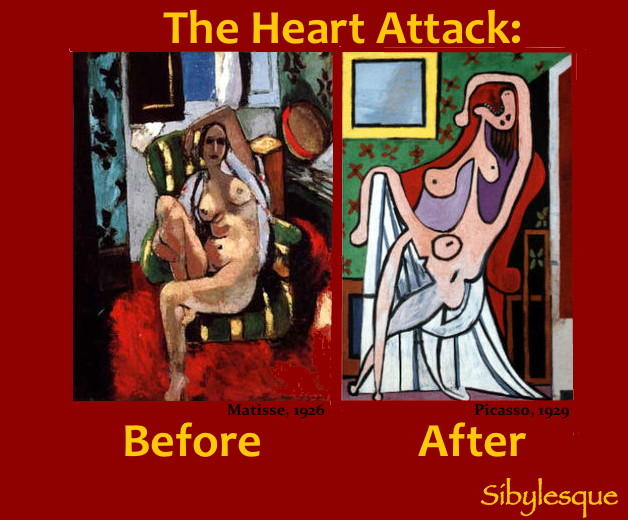
More women in Australia die from Heart Disease than cancer. This is also true in the UK and the US. This fact often surprises women. We are so attuned to raising money for breast cancer research, we assume it is the number one killer. This misperception makes a heart attack for us dangerous. We don’t recognise the symptoms. We put symptoms like nausea and chest pain down to something we ate or anxiety.

A recent article by Martha Weinman Lear in The New York Times (The woman’s Heart Attack, 26 Sept 2014) highlighted the difference between male and female heart attacks. Martha, who had a heart attack herself, explains that more men have the classic dramatic chest-clutching ‘Hollywood’ heart attack.

Sibylesque Heart Attack

Most women do not have drama on their side prompting those around them to call an ambulance. The symptoms of a heart disease could simply be fatigue and insomnia. Something that we often assume is NORMAL.

It’s back to the same old message for women’s health. Keep in tune with your own body. Take action when things don’t feel quite right. The life you save may be your own.

HOME

Please Squeeze: Why Pelvic Floor Exercises Count at your age!

by Annie James

Sibylesque Pelvic Floor Joke quote

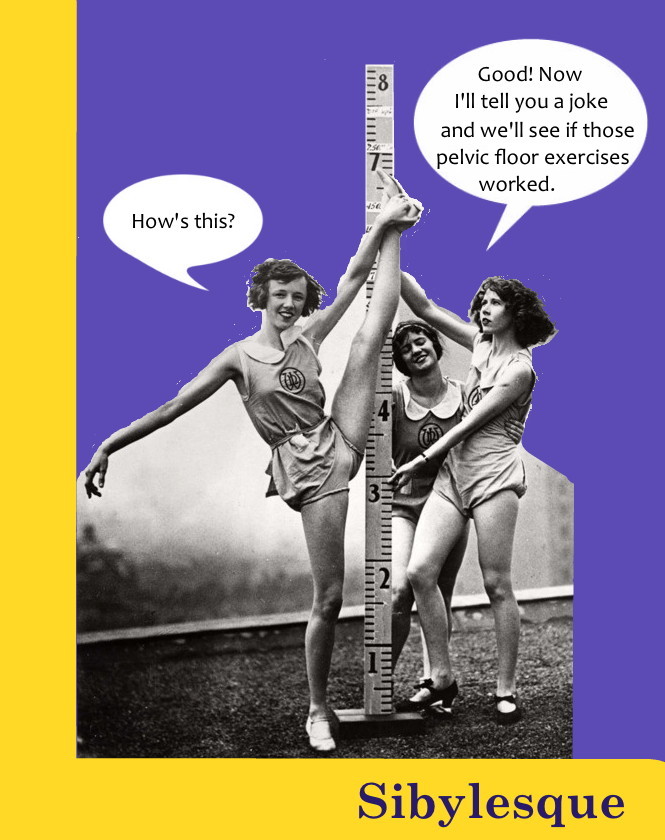
A bit of essential leg-crossing when there’s no loo nearby? Not too keen on star jumps or sneezing bouts? The resorting to panty-liners to blot the odd leak? These are all signs that your pelvic floor muscles would like some attention, some action.

With age and especially following a vaginal delivery, the cradle of muscles around urethra (urine outlet) become less effective in contracting well and exercises may be all that’s required to make them effective again. The results can be seen quickly and the problem resolved. If you don’t know whether you’re using the correct muscles you can try stopping your urine flow mid-stream. This is not recommended as an exercise but will give you the correct sensation of ‘drawing up’ your pelvic floor and you’ll then be able to do it whenever you want.

Sibylesque  Pelvic Floor Joke

Ideally do it at least 6 times, 2-3 times a day, and try and vary length of hold, and how high you feel you’re lifting. It shouldn’t be obvious to anyone that you’re doing the exercises so make sure you breath normally! I know it seems a lot of exercise for one lot of muscles but if you do them say, once at traffic lights, once lying in bed and once when cleaning teeth or waiting for a coffee, it’s a breeze.

Please note, if you don’t have an idea of how to do the exercise or the problems continue, do see your GP or a specialist Physiotherapist for advice and other treatment.

Believe me, you’ll enjoy a much happier older age if you keep these muscles active; improves enjoyment of sex too!

You will find everything you could ever want to know about incontinence and more if you download this brochure from the Continence Foundation of Australia.

…………………………………………………………………………………………….

Babylonian Sibyl

Babylonian Sibyl

Annie James is an adventurous spirit, who is passionate about women’s health. She has worked as a physiotherapist and also hikes and plays tennis.

Photo source: Social History Archives

HOME

How to postpone aging? Get a grip. Really.

by Kerry Cue

Sibylesque old age quote 2When does old age begin? Well, traditionally turning 65 years of age marked the beginning of old age. But now Warren Sanderson, a professor of social and behavioral sciences at Stony Brook University, offers a different view point. In an article by Judith Graham, (On New Measurements of Aging, New York Times, 16 SEP 2014) he said ‘We should consider people as old when they near the end of their life: when their remaining life expectancy is 15 years or less.’ Compare two 65 year olds. If one has a life expectancy of, say, 5 years, and the other, 25 years then the first, obviously, is much closer to the end of life stage.

What measure places people in the old age category?

Surprisingly, Prof Sanderson’s research shows that the strength of a person’s handgrip is an accurate indicator of different rates of aging. Data has been collected for 50,000 subjects from the USA, Europe, japan and China.

So GET A GRIP.

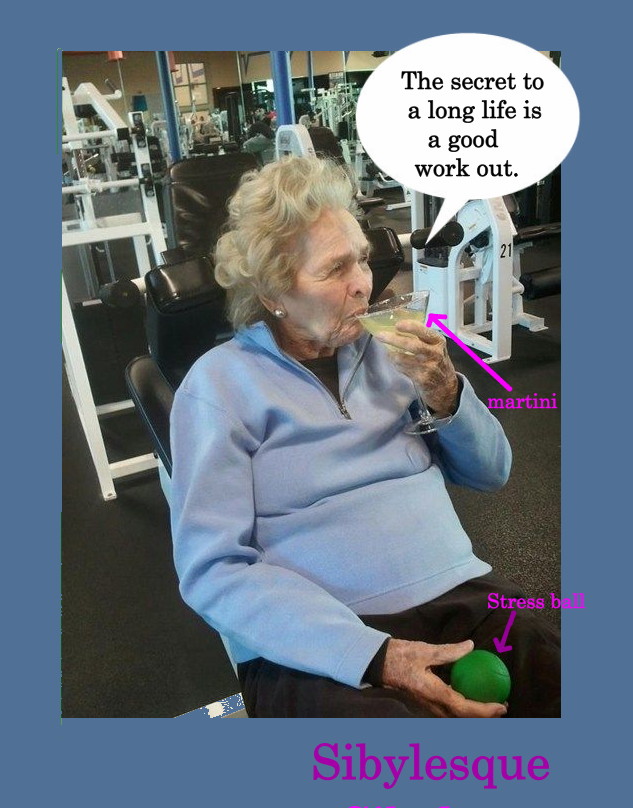
Sibylesque Long Life Martini

And one more thing, Prof Sanderson is now looking another indicator of old age: THE TIME IT TAKES TO GET OUT OF A CHAIR.

So you need LIFT OFF. Work on it.

You might also enjoy the article on Aging and the Pelvic Floor here.

Photo source: Huffinton Post

HOME

What’s your poison …. Botox, flu shots or designer drugs?

by Kerry Cue

Sibylesque Vaccination quote

We, Baby Boomers, are the last generation that can remember kids who suffered from Diphtheria, Polio and/or Whooping Cough. As kids many of us caught the common childhood diseases including  measles, german measles, mumps and, definitely, Chicken Pox. In Melbourne, in the 1950s, my next door neighbour Roy had TB.  When I was 8 years old, he taught me a skill he picked up in the Sanatorium, namely how to blanket stitch a felt toy.

Sibylesque girliron lung

It is not surprising then that most of us are pro-vaccination. For those in doubt look here. This is a You Tube clip posted by the Mayo Clinic of a baby with Whooping Cough. Parents of a baby afflicted with such a terrible disease as Whooping Cough say they would do anything to help their little baby, but it is too late.

So what vaccinations might be appropriate for our 50+ age group?

Flu shots.

Pneumonia Vaccination especially if you are prone to respiratory diseases.

And, the latest, SHINGLES SHOTS.

Shingles is a very painful condition caused by the Chicken Pox virus that lays dormant in the nerve roots near the spine of anyone who ever had the disease. According to the AMA the ‘risk and severity of the condition increases markedly with age’. The American-made vaccine, Zostavax , has been approved by the TGA (Therapeutic Goods Administration) for use by Australians aged 50 years or older. The vaccine has not been added to the Pharmaceutical Benefits Schedule yet so a Shingles Shot is expensive (Around $200), but it is a price any shingles sufferer would gladly pay if they could.

Finally, we often get Top Up shots, especially new grandmothers, for the standard vaccinations we had in our youth including measles, mumps and so on. You would need to consult your medical practitioner for further information.

Photo: Unknown Source

HOME

Hey Grandma, try this … build your grandchild’s imagination!

by Penny Cook

Sibylesque bob Newhart quote laughterWho could have ever have predicted that when recycle bins were installed in homes and offices all over Australia, the future creativity of the nation would be under threat! Don’t get me wrong. Recycling is the right thing to do for the planet and, I can tell there has been a huge change in social behavior because early childhood settings all over the country are suffering from a lack of cereal boxes, toilet rolls, milk cartons (remember them), egg cartons, corks and the like!! All of which are ‘gold’ to the imaginations of our youngest innovators.

Sibylesque iPod kidA natural part of how children learn is to make sense of the world they’re experiencing by re presenting their thinking. That’s why they pretend to be someone they’re not (dramatic play), use bananas as telephones and understand that 3 cereal boxes and 2 toilet rolls is really a robot. Without ready access to a range of discarded but potentially fabulous resources, children will miss out on opportunities to be creators and innovators.

What used to go to preschools and schools as ‘junk’ and was transformed into amazing creations, now ends up in recycle centres to be turned into toilet paper, envelopes and tyres. Early years settings are crying out for recycled goods. I have seen teachers guiltily deconstruct a mermaid that didn’t go home with its owner, to recycle the recycling!! Without the ‘junk’ the alternative is pressure to purchase pre packaged expensive bags of coloured sticks, straws, feathers and sequins or alternatively, pre packaged expensive natural materials. Either way children need to and will be creative.

In northern Italy, the city of Reggio Emilia, well known internationally for their early childhood centres, has developed Remida, a centre for organizing and displaying discarded materials to be used as creative resources. Schools can go there and stock up on all kinds of interesting recycled materials, which then get translated into the most amazing creations. There is an endless supply because businesses and industries work in partnership with the city and recognize the importance of the creative process in learning. I’m wondering, is it possible to use face book and social media to influence another change in social behavior –putting in a ‘create and innovate’ step before the recycle depot.

Sibylesque Creative StationOnce at kindy, a child had a plaster cast on his leg. At the same time there was a young boy who didn’t speak. This boy went to the never ending supply of ‘junk’ material, found two milk cartons, cut the bottoms out, opened out the tops and then placed a carton on each leg. That ‘spoke’ to me. It told me this boy wanted to know what it felt like to walk with plaster on his legs. I’d say I was seeing empathy- wanting to understand from another’s point of view. If there wasn’t access to the recycling, I might never have known that about the boy who didn’t speak.

So…tip out the recycling, re badge it as ‘the creative station’, throw in scissors, tape and a glue stick and watch what the kids do!! Or, bundle it up and take it (washed and sorted) to the local early childhood centre or school. The children of Australia will be extremely createful!!

Also check out: how a child’s creativity and imagination helps them deal with anxieties and phobias.

……………………………………………………………………………………

Penny CookPenny Cook has been an early childhood educator for over 30 years. She loves to travel  – anywhere. Penny is a mother and ‘Nan Pen’, who is continuously fascinated and amazed by her two young grandchildren.  She has always wanted to live in  a tree house by the beach …..it’s never too late!!

Photo source: Popsugar, Familysponge

HOME

Do modern parenting styles create phobias in kids?

by Kerry Cue

Sibylesque Imagination Quote 2

Yes and No. Parents with Social Phobia, for instance, may pass their fears on to their children. However, we, the Sibyls, know that children have vastly different personalities, coping styles and anxiety levels. And they grow up with many influences including dominating siblings, unstable family structures, economic pressures, school, the culture and the media.

Nevertheless, studies show that parents can help reduce anxiety levels in young children by encouraging:

  1. Creative Play: In The Serious Need for Play (Scientific American Mind, 28 JAN 2009) Melinda Wenner cites studies that show ‘Free, imaginative play is crucial for normal social, emotional and cognitive development. It makes us better adjusted, smarter and less stressed.’
  1. Sibylesque Po Kung Fu PandaRisk Taking: Children need to encounter risks and overcome fears on the playground,” said Ellen Sandseter, a professor of psychology at Queen Maud University in Norway. “I think monkey bars and tall slides are great. As playgrounds become more and more boring, these are some of the few features that still can give children thrilling experiences with heights and high speed.” (See: Can playgrounds be to safe? John Tierney, New York Times, 18 JUL 2011)

Research by Professor Sandseter supports the argument that children are born to take risks and this is how they learn to deal with such things as fear of heights. If a child does not tackle a fear of heights, say, then they can develop a phobia. Sometimes parents too need to be encouraged to take risks with their parenting. And these studies help start the conversation.

Does Helicopter Parenting harm children? You might want to read: Help My Bubble Wrap Kid Just Turned 40!

Photo Source: Reblogger blog.

…………………………………………………………………

HOME

I will not be a stereotype when I grow old

Sibylesque Paul Coelho QuoteChange is a Beautiful Thing is a part of The Beauty Project by New York director Kathryn Ferguson. This short  film does not whitewash aging. It is full of the foibles, doubts and uncertainties of growing old. Yet it also bubbles with individuality, vitality and the honesty age, hopefully, brings.

HOME

How did childhood become a prison sentence?

by Kerry Cue

Sibylesque Nature Play Quote

We are the generations, who roamed free. We rode our bikes unsupervised. Explored the neighbourhood. Played in the street. Our grandchildren live indoors. (See The Last Child in the Woods book review) This is cause for great concern. Sibyl Helen Elliott writes about the joys of taking grandchildren into nature. There is another side to this story. Childhood is diminished if children do not experience nature. Now the research confirms our fears.

Results from the Australian State of Play Report, 2012, comprising 8 – 12 year old children, their parents and grandparents published in Primary Focus, the SAPPA (South Australia Primary Principals) Magazine include:

*Indoors: 9 out of 10 kids spend more time playing inside than out.

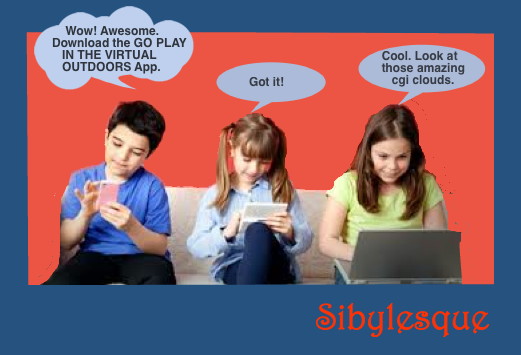
Sibylesque outdoor play app

*A lack of inspiration: 37% of kids run out of ideas for play.

*A lack of time: Afterschool activities limit the time children have to play outdoors.

*A lack of opportunity: 37% of kids report they don’t have anyone to play with outside as almost half the kids they might play with are indoors plugged into technology.

A growing body of research shows us that outdoor play leads to better physical and mental health, has positive effects on cognitive function and learning, and reduces the incidence of behavioural problems.” Maria Zotti, Nature Play, SA.

Peter Dunstan, Principal Kilkenny PS, SA, writes in Primary Focus that outdoor play fosters “wonderment, independence and freedom” as well as “social skills, imagination, creativity and problem solving”.

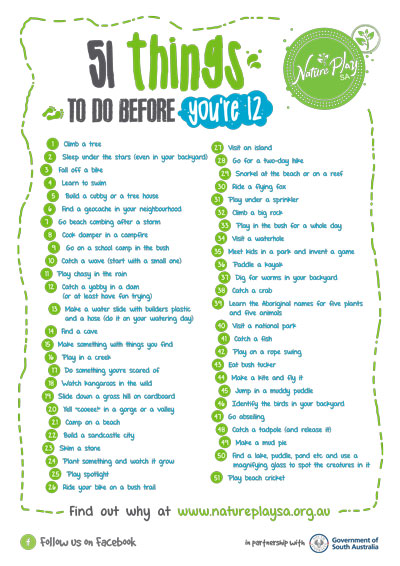
So concerned are the South Australian Primary School Principals they have combined with Nature Play, SA (A NFP organisation) to promote outdoor play. Nature Play, SA has produced this poster: 51 Things to Do before you’re 12. Pass it on!!!!!!!

51things_NPSA

Photo: Unsourced

HOME