These are the best years of your life. What? Middle school? That’s it!

The Sibyls

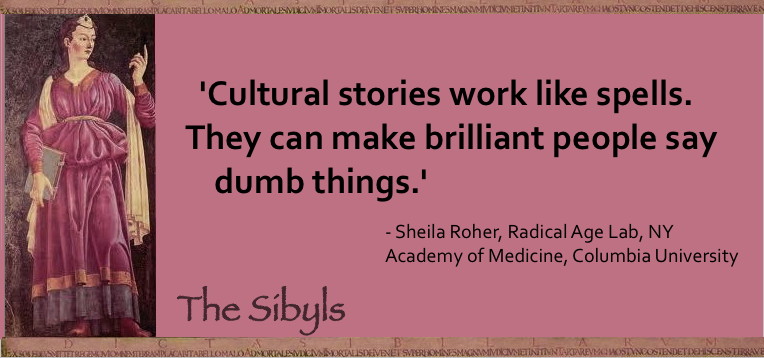
Radical Age quote

We Sibyls are concerned with the impact negative attitudes to aging have on our health. Toxic stereotypes of ‘the little old lady’ are prevalent in the medical world, At my age doctor John Glen was an astronaut, in the media, If you think you are old guess what? You are aging fast and in our own conversations, Why you should avoid geriatric talk.
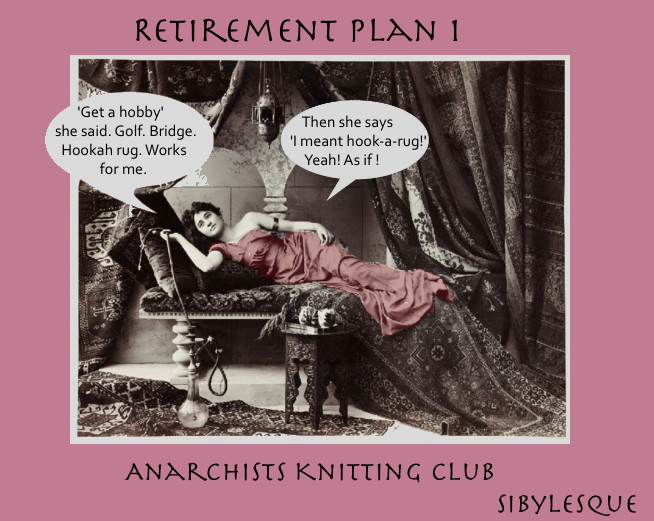
Anarchists knitting Club 1

Sometimes, however, we don’t realise just how ingrained these attitudes are in the culture. In this fascinating lecture Sheila Roher, founder of Radical Age Lab, University of Columbia, asks the audience ‘how many of you were told when you were a child or a teenager that these are the best years of your life?’. ‘That’s a terrifiying statement!’ exclaims Roher. ‘Like I peaked at nine … middle school is it?’

Watch the video for some profound philosophical thinking on aging.

You will find more discussion on this topic at Radical Age Movement Blog.

HOME

Can you die from a broken heart? Yes! It could happen to you.

by Kerry Cue

Sibylesque Heart Foundation Quote

More women in Australia die from Heart Disease than cancer. This is also true in the UK and the US. This fact often surprises women. We are so attuned to raising money for breast cancer research, we assume it is the number one killer. This misperception makes a heart attack for us dangerous. We don’t recognise the symptoms. We put symptoms like nausea and chest pain down to something we ate or anxiety.

A recent article by Martha Weinman Lear in The New York Times (The woman’s Heart Attack, 26 Sept 2014) highlighted the difference between male and female heart attacks. Martha, who had a heart attack herself, explains that more men have the classic dramatic chest-clutching ‘Hollywood’ heart attack.

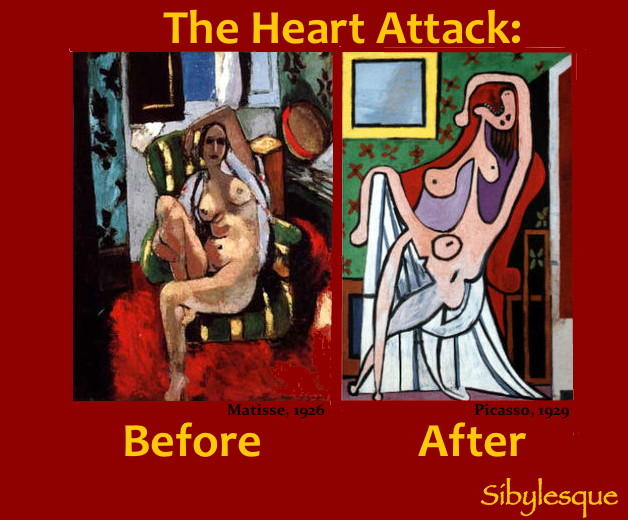
Sibylesque Heart Attack

Most women do not have drama on their side prompting those around them to call an ambulance. The symptoms of a heart disease could simply be fatigue and insomnia. Something that we often assume is NORMAL.

It’s back to the same old message for women’s health. Keep in tune with your own body. Take action when things don’t feel quite right. The life you save may be your own.

HOME

Please Squeeze: Why Pelvic Floor Exercises Count at your age!

by Annie James

Sibylesque Pelvic Floor Joke quote

A bit of essential leg-crossing when there’s no loo nearby? Not too keen on star jumps or sneezing bouts? The resorting to panty-liners to blot the odd leak? These are all signs that your pelvic floor muscles would like some attention, some action.

With age and especially following a vaginal delivery, the cradle of muscles around urethra (urine outlet) become less effective in contracting well and exercises may be all that’s required to make them effective again. The results can be seen quickly and the problem resolved. If you don’t know whether you’re using the correct muscles you can try stopping your urine flow mid-stream. This is not recommended as an exercise but will give you the correct sensation of ‘drawing up’ your pelvic floor and you’ll then be able to do it whenever you want.

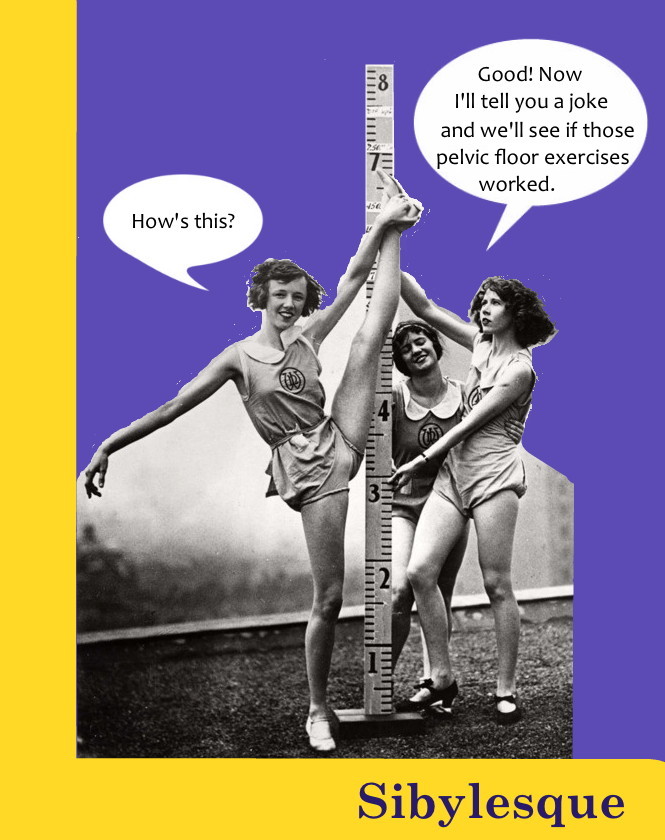
Sibylesque  Pelvic Floor Joke

Ideally do it at least 6 times, 2-3 times a day, and try and vary length of hold, and how high you feel you’re lifting. It shouldn’t be obvious to anyone that you’re doing the exercises so make sure you breath normally! I know it seems a lot of exercise for one lot of muscles but if you do them say, once at traffic lights, once lying in bed and once when cleaning teeth or waiting for a coffee, it’s a breeze.

Please note, if you don’t have an idea of how to do the exercise or the problems continue, do see your GP or a specialist Physiotherapist for advice and other treatment.

Believe me, you’ll enjoy a much happier older age if you keep these muscles active; improves enjoyment of sex too!

You will find everything you could ever want to know about incontinence and more if you download this brochure from the Continence Foundation of Australia.

…………………………………………………………………………………………….

Babylonian Sibyl

Babylonian Sibyl

Annie James is an adventurous spirit, who is passionate about women’s health. She has worked as a physiotherapist and also hikes and plays tennis.

Photo source: Social History Archives

HOME

How to postpone aging? Get a grip. Really.

by Kerry Cue

Sibylesque old age quote 2When does old age begin? Well, traditionally turning 65 years of age marked the beginning of old age. But now Warren Sanderson, a professor of social and behavioral sciences at Stony Brook University, offers a different view point. In an article by Judith Graham, (On New Measurements of Aging, New York Times, 16 SEP 2014) he said ‘We should consider people as old when they near the end of their life: when their remaining life expectancy is 15 years or less.’ Compare two 65 year olds. If one has a life expectancy of, say, 5 years, and the other, 25 years then the first, obviously, is much closer to the end of life stage.

What measure places people in the old age category?

Surprisingly, Prof Sanderson’s research shows that the strength of a person’s handgrip is an accurate indicator of different rates of aging. Data has been collected for 50,000 subjects from the USA, Europe, japan and China.

So GET A GRIP.

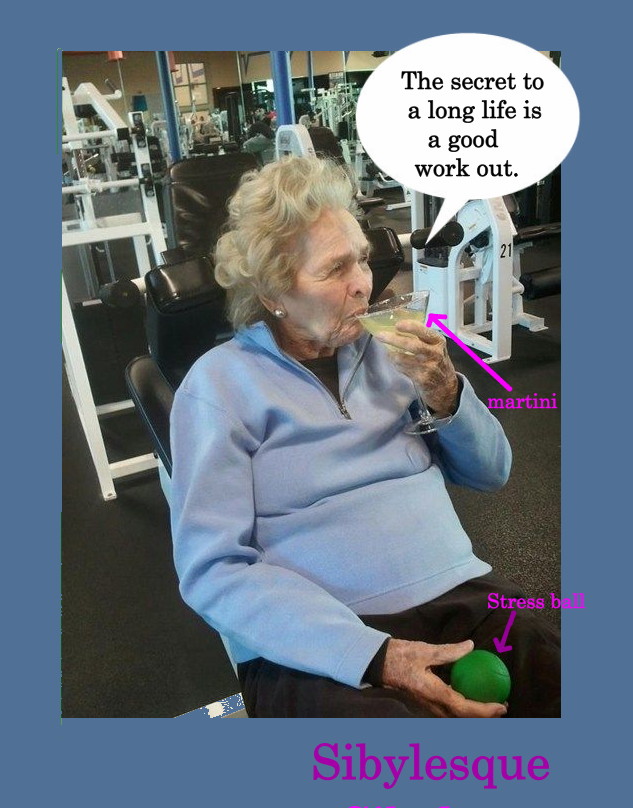
Sibylesque Long Life Martini

And one more thing, Prof Sanderson is now looking another indicator of old age: THE TIME IT TAKES TO GET OUT OF A CHAIR.

So you need LIFT OFF. Work on it.

You might also enjoy the article on Aging and the Pelvic Floor here.

Photo source: Huffinton Post

HOME

What’s your poison …. Botox, flu shots or designer drugs?

by Kerry Cue

Sibylesque Vaccination quote

We, Baby Boomers, are the last generation that can remember kids who suffered from Diphtheria, Polio and/or Whooping Cough. As kids many of us caught the common childhood diseases including  measles, german measles, mumps and, definitely, Chicken Pox. In Melbourne, in the 1950s, my next door neighbour Roy had TB.  When I was 8 years old, he taught me a skill he picked up in the Sanatorium, namely how to blanket stitch a felt toy.

Sibylesque girliron lung

It is not surprising then that most of us are pro-vaccination. For those in doubt look here. This is a You Tube clip posted by the Mayo Clinic of a baby with Whooping Cough. Parents of a baby afflicted with such a terrible disease as Whooping Cough say they would do anything to help their little baby, but it is too late.

So what vaccinations might be appropriate for our 50+ age group?

Flu shots.

Pneumonia Vaccination especially if you are prone to respiratory diseases.

And, the latest, SHINGLES SHOTS.

Shingles is a very painful condition caused by the Chicken Pox virus that lays dormant in the nerve roots near the spine of anyone who ever had the disease. According to the AMA the ‘risk and severity of the condition increases markedly with age’. The American-made vaccine, Zostavax , has been approved by the TGA (Therapeutic Goods Administration) for use by Australians aged 50 years or older. The vaccine has not been added to the Pharmaceutical Benefits Schedule yet so a Shingles Shot is expensive (Around $200), but it is a price any shingles sufferer would gladly pay if they could.

Finally, we often get Top Up shots, especially new grandmothers, for the standard vaccinations we had in our youth including measles, mumps and so on. You would need to consult your medical practitioner for further information.

Photo: Unknown Source

HOME

Sense of Purpose

 by Kerry Cue

Living with purpose quotePaula SpanLiving with Purpose, (New York Times, 3 JUN 2014) written by The New Old Age columnist Paula Span (left) is a significant article, which provides both insight and inspiration on the subject of aging well. The conclusion summarised in the article and backed by extensive research, applies equally to all age groups.

A sense of purpose has many health benefits. It contributes to ‘satisfaction and happiness, better physical functioning and even better sleep.’

‘They want to make a contribution’ explained Dr Patricia Boyle, Rush University, Chicago, who conducted a longitudinal study of 1,000 elderly subjects. ‘They want to feel a apart of something that extends beyond themselves.” A sense of purpose can come from mentoring as well as passing on memories and experience to the young.

Sibyls Emblem Red Frescoe

This is, of course, the reason the Sibylesque blog came into being. Why not become a Sibyl? What memories, experience or words of wisdom would you like to pass onto the young, or not so young?

 We, THE SIBYLS, declare Paula Span an Honorary Sibyl for her generosity of spirit in sharing her personal stories, insight and wisdom.

When the Times Comes coverPaula Span is journalist with extensive experience writing for The Washington Post, The Wall Street Journal and many other publications. She is also the author of When the Times Comes: Families with Aging Parents Share their Struggles and Solutions. You can learn more about Paula at her website.

Photo source: Paula Span’s website.

HOME

At my age, doctor, John Glen was an astronaut!

by Kerry Cue

Roman border  dark red

dark red quote 1 The United States contains more people aged 65 and older than the total population of Canada.dark red quote 2

…………………………….The Demographics of Aging Report

Sibylesque Signature dark redRoman border  dark red


….

…………………………………………………………………………………………………………………………………………………………..

At your age, what do you expect?


When consulting with your doctor about some illness or injury, you may hear the words, “Well, at your age, what do you expect?” In other words, your illness is ‘your age’. You may want to respond, “At my age, Doctor, John Glen was an astronaut”. John Glen went into space at 77 years of age! Unfortunately, your health provider would more than likely mumble [under their breath], “You’re no John Glen”.

Pelvic Floor Exercises on Beach Now imagine you are a 70-year -old American with a painful knee. What does it actually mean if your doctor glibly comments ‘Well, at your age, what do you expect?’ According to the statisticians there are 18 million Americans in your 65 – 74-year-old age group. As there are 18 million Americans ‘your age’ does that mean they are all limping about the place because of painful knees? The flaw in this logic is simple. You cannot make assumptions about the health of one person from group statistics. When the sample size is 18 million, such assumptions become a joke.

If your doctor thinks YOUR AGE is the disease, he or she might miss a more specific diagnosis. How do you respond to this type of comment by a medical practitioner? One 70-year-old had the answer. In her book, [published over 30 years ago!], ‘Mirror, Mirror, The Terror of Not Being Young’, author, Elissa Melamed, tells the story of a 70-year-old who visited her doctor with a painful right knee. “You’re 70 years old, what do you expect?” he insisted. “My left knee is 70 too”, she replied, “and it’s fine”.

Photograph from USA Social History Archives

HOME


Why you should avoid geriatric talk

Roman border  dark red

dark red quote 1


I’m not senile… If I burn the house down it will be on purpose.dark red quote 2

…………………………………..Margaret Attwood, The Blind Assassin

Sibylesque Signature dark redRoman border  dark red …………………………………………………………………………………………………………………………………………………………………

Age makes weary, but words condemn.

senior hippies wrinkleOld age creeps up on us all, but we can stay lively all our lives. Old Age, however, has had a long history of bad press. As a consequence, it is very easy to develop a ‘geriatric’ mindset and start using geriatric language. This is how it works. One day, without realising it, you say ‘I had a fall’ rather than ‘I fell over’, ‘I had a funny turn’ instead of ‘I felt dizzy’ and ‘My mind is going’ or ‘I can’t remember a thing’ in stead of ‘I forgot’.

This is important. Research shows that immersing yourself in ‘debilitating’ language slows you  down. Scientists have actually measured the walking pace of subjects. Young and old. The reverse is also true. Using ‘energetic’ language will speed you up.

What more can I say? Go wild. It’ll do you some good.

Reference: How to Age, Anne Karpf,  The School of Life (2014), p48

HOME