 It ain’t over until The Fat Lady SCREAMS
ff………….t-shirt


Photo source: Social History Archives, 1953

Shattering Stereotypes
 It ain’t over until The Fat Lady SCREAMS
ff………….t-shirt

Photo source: Social History Archives, 1953

 I want to start very near the beginning of the tradition of Western literature, and its first recorded example of a man telling a woman to ‘shut up’; telling her that her voice was not to be heard in public.
Mary Beard, The Public Voice of Women, LRB, 20 MAR 2014, p11.
 Mary Beard is the Professor of Classics at Newnham College, Cambridge, the Classics Editor of the Times Literary Supplement and contributor to the London Review of Books. Beard recently spoke out about the silencing of women’s voices in public in lectures at the British Museum and in the LRB article (above).
Beard quotes the ‘wet-behind the ears’ Telemachus in Homer’s Odyssey silencing his mother, the savvy middle-aged Penelope: ‘Mother,’ he says, ‘go back up into your quarters, and take up your own work, the loom and the distaff … speech will be the business of men, all men, and of me most of all; for mine is the power in this household.’
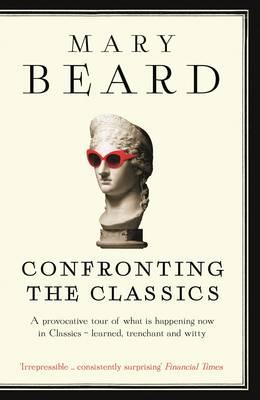 We talk of online trolls viciously attacking any women with an opinion today on Twitter, say, but Beard points out that ‘silencing women’ has been ingrained in Western Culture since it’s conception. Following an appearance on television, Beard became the target of such trolls, who compared her genitalia to rotting vegetables. When she Tweeted that she found these comments ‘gob-smacking’, one commentator in a leading British magazine reported Beard’s Tweet with the following words: ‘The misogyny is truly “gob-smacking”, she whined.’
‘It’s not what you say that prompts it’ explains Beard, ‘it’s the fact you’re saying it.’ Women, apparently, whine, bleat, whinnie and yap. This is the language used to described women’s voices over two millennia.
The viciousness of the online attacks cannot be overstated. ‘Shut up you bitch’ is a fairly common refrain’ said Beard. ‘I’m going to cut off your head and rape it’ was one tweet I got.’
Beard wants us to look at our culture and the tradition of silencing women in public. If women are not allowed a voice of authority in public, we have no voice at all..
And ‘We need to work that out before we figure out how we modern Penelopes might answer back to our own Telemachuses …’

Photos: Mary Beard Website

 The secret of a happy marriage remains a secret.
………………………….Henny Youngman, American Comedian...

Photo Source: Huffington Post
 All sorrows can be borne if you put them into stories.
……………………………Isak Dinesen, Author, Out of Africa quoted in The Twelfth Raven

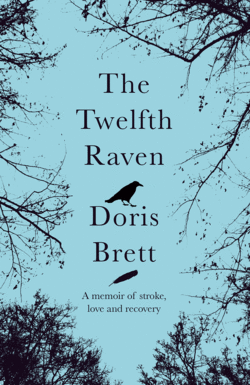 The Twelfth Raven:
The Twelfth Raven, according to an old English rhyme, brings joy for tomorrow. Sometimes, I wish poets wrote news headlines then, instead of the ‘Syrian Bloodbath’ headline, you might read something like ‘Trickster God’s Toy with Us Again’. The Trickster God’s certainly overthrew all that defines normality in Doris Brett’s life. Firstly, Brett’s husband Martin suffered, at 59, a stroke followed by a superbug, heart valve failure and open-heart surgery. Then Brett needed a radical mastectomy.
 Read this book if you want to learn how to defend yourself against the Healthcare system. But Brett is a poet. The language is lyrical. Dreams untangle knots in reality to reveal some profound truths. Read this book, if you want to gain some insight into the inner journey of an insightful writer in a family crisis. Brett is ruthlessly honest and very generous in this regard.
A recommended read.
We, THE SIBYLS, declare Doris Brett an Honorary Sibyl for her ruthless honesty, her unflinching endurance and her ability to provide insights into life’s hardships by weaving her brand of lyrical magic.

My Diet Plan: Make all my friends cup cakes.ff………….Coffee Mug
This is the latest diet … it’s so mathematical, but so out of proportion.

Photo source: moviesinbw blog.

 We’ve given those girls everything.
……………………………………Virginia, NSW, RN, Life Matters, ABC Talkback,28 MAR 2014
…………………………………………………………………………………………………………………………………………………………..
When this talkback segment came on the radio I nearly ran the car off the road. This was brutally honest comment, talkback radio at its best. I had to stop the car and listen. Here is Virginia, NSW, again:
‘My daughter is 32 this year …. Anyway, that generation of girls … all highly educated, all got degrees, very career driven young women … but I’ve noticed there is a real syndrome among my friends … I’m now 60 …those girls … are very critical and, I would say in some cases, downright abusive of their mothers. … We talk about it among ourselves and it’s horrible. Virginia, NSW, RN, Life Matters, ABC Talkback,28 MAR 2014
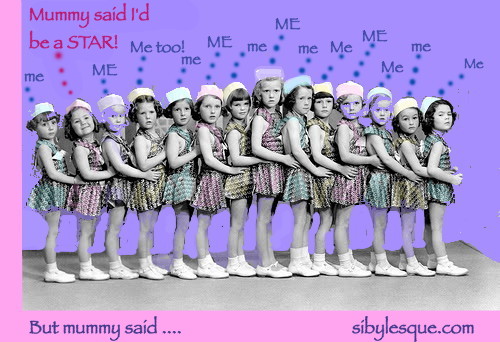 What’s going on? Surely feminist daughters are independent, self-determining young women, who do not depend on their mothers. Or, could it be that Helicopter Parents – across the parent spectrum from mild hoverer to tyrannical Tiger Mum – have created needy offspring? Helicopter parenting began in the 1970s when Penelope Leach and other child rearing gurus urged parents to build their children’s self-esteem. Parent’s had to be hyper-vigilant in case their child missed out on an A, or an invitation to a party, or being picked for a sports team to make sure their child’s self-esteem didn’t collapse like a house of cards.
Mea Culpa. Many parents from the 1970s on are guilty to some degree of fretting over their child’s self-esteem. But this brings about another problem: EMOTIONAL DEPENDENCE. In her article, The Ties that Unwind (The Weekend Australian Magazine, 1 Mar 2014),
 Kate Legge explored the different expectations children have of parents across the generations. There has been a generational shift. People aged 60+, says Kate, grew up believing that children should be fed, clothed and schooled (and, therefore, loyal to the family.) Whereas younger adults between 30 and 50 want and often demand EMOTIONAL SUPPORT and if the parents are not forthcoming they will go elsewhere – to friends or therapists – to get it.
This is the Catch 22 of modern parenting. Children, obviously, need emotional support. (There. There. Did the big, bad thunder frighten you?) But children also have to mature into independent young adults. (Yeah! Life’s a bitch. Suck it up Princess.) In his article on Slate.com, Teen Spirit: Helicopter parenting has crippled American teenagers: Here’s how to fix it, American psychologist, Dan Griffin, calls this parental role change as moving from the more cheerful, obviously, Cheerleader to tougher Coach. But how do parents get this move right?
Could the angry daughter syndrome be related to the feminist mantra: You can be anything you want to be. You can have it all? Mothers, teachers and career advisers wanted each girl to realise her full potential. This mantra was delivered with enthusiasm and the best intentions in the early days of feminism. (Have a look at Australian Content Magazine For Women Who Want It All)
 This is fine talk for a cheerleader, but as a tough coach the possibilities are unintentionally overstated. A girl cannot be anything or everything she wants to be. She cannot become an A-grade tennis playing, ballerina, plumber, film-star-lawyer princess-bride, for instance. Maybe, just maybe, these daughters are angry with their mothers because ‘mum’ promised them the world and the world hasn’t delivered. Besides, mum is meant to fix everything, isn’t she? As paediatrician Donald Winnicott wrote in 1953, the Good Enough Mother must fail, eventually, to fulfil her child’s every need. Yep! That sounds about right. Suck it up princess.
Then again, as the first batch of feminist daughters of stay-at-home mothers, we were often outlandishly critical of them too. And so the wheel turns.
Dance photo:Alice Murdoch Adams dance school in Calgary from the chronicallyvintage blog
“I wish that other women would let other women age gracefully. Women take it as something personal that they are getting older. They think that they failed somehow by not staying 25. This is crazy to me because my belief is that it’s a privilege to get older – not everybody gets to get older’
……………………………..Cameron Diaz, actress, 41.
In the 1967 film, The Graduate, Anne Bancroft played Mrs Robinson, a bored-housewife living in a loveless marriage. When the 21-year-old Ben Braddock played by Dustin Hoffman visits the Robinsons, urged on by his parents (Mr Robinson is a partner in a legal firm with Ben’s father), he is seduced by the much older Mrs Robinson. Ben, however, falls in love with Elaine, the Robinson’s daughter, and in a climactic ending, the young couple run off together.

The Graduate 1967
Anne Bancroft and Dustin Hoffman
At the time, Anne Bancroft was 36-years-old and, in fact, only 6 years older than Dustin Hoffman. So, historically, in Hollywood you are branded ‘the older woman’ at 36 years of age.
Forty-five plus years on The Graduate highlights a more disturbing issue. In the film, Mrs Robinson is a ‘formidable’ character. There is a word you do not hear any more. ‘Formidable’ applied to an older woman in a position of authority. The ‘formidable woman’ was matronly and someone to reckon with. She stood for definite principles. She didn’t tolerate fools and often held the position of Hospital Matron, Head Mistress or, even, the family Matriarch. When we were young girls many ‘formidable women’ – Reverend Mother, for starters – had our measure. Where are they today? These days, older women, who exercise authority are described as ‘ball breakers’, ‘old dragons’ or, in the case of the matriarch, ‘a Control Freak’. Is it the ‘management team’ and their spin that has replaced the ‘formidable woman in the workplace? Has the mass movement of women out of the home and into the workplace in the 1970s unthroned the matriarch? Curious, isn’t it?

Anne Bancroft, 70, 2001
At 70 years of age Anne Bancroft (above) still looked impressive. She won an Oscar in 1962 for her role in The Miracle Worker. She was happily married to her second husband, Mel Brooks, for 45 years. They had one son. Sadly, she died in 2005.
Photo Source: Film Promotion Pic and Salon.com
When I am an old woman I shall wear purple………….Jenny Joseph, Warning, Poem, 1961

Red Hat Society
Jenny Joseph’s poem has gained something of a cult following. Today there are Red Hat Societies that encourage members to go out in public wearing purple dresses and red hats. They have a lot of fun and raise money for charity – insert applause here – and, of course, the Red Hat ladies don’t go unnoticed in public.
Such societies, however, rather defeat the idea of the older woman as a respected individual by turning her into a red hat, purple dress-wearing stereotype. Jenny Joseph aptly expressed her unique eccentricities in her poem, but why turn yourself into a Jenny Joseph clone?
There is, however, a more insidious problem concerning fashion for older women.
In her book FASHION AND AGE: Dress, the body and later life, (Review: Cheryl Buckley, Times Higher Education, 19 SEP 2014) Julia Twigg insists that as women age they become estranged to fashion and begin to wear “rectangles and squares” in sombre colours with little ornamentation, instead of choosing clothes that fashionably drape and shape our older selves.
 It is the curse of the ‘chunky ¾ length pants and polo fleece tops’, the uniform worn by older women on bus trips! This garb is the real world equivalent to Harry Potter’s Invisibility Cloak.
Fashion is fun but it’s not for everyone. Moreover, older women can wear what they bloody well like. They’ve earned this right. But fashion also serves a purpose. Dowdy or dull outfits scream ‘I’ve given up’. If you are not interested in yourself, who else will be?
Yes! You do get more respect if you dress smartly in public. You needn’t stop there. Some older women don amazingly zany outfits and they are, indeed, an inspiration for all ages. Here they are, women from the Advanced Style Blog. Ari Seth Cohen wanders the streets of New York taking pictures of fashionable women in the 60s, 70s and 80s. And they look fabulous, darling!

Beatrix Ost Fashion Diva
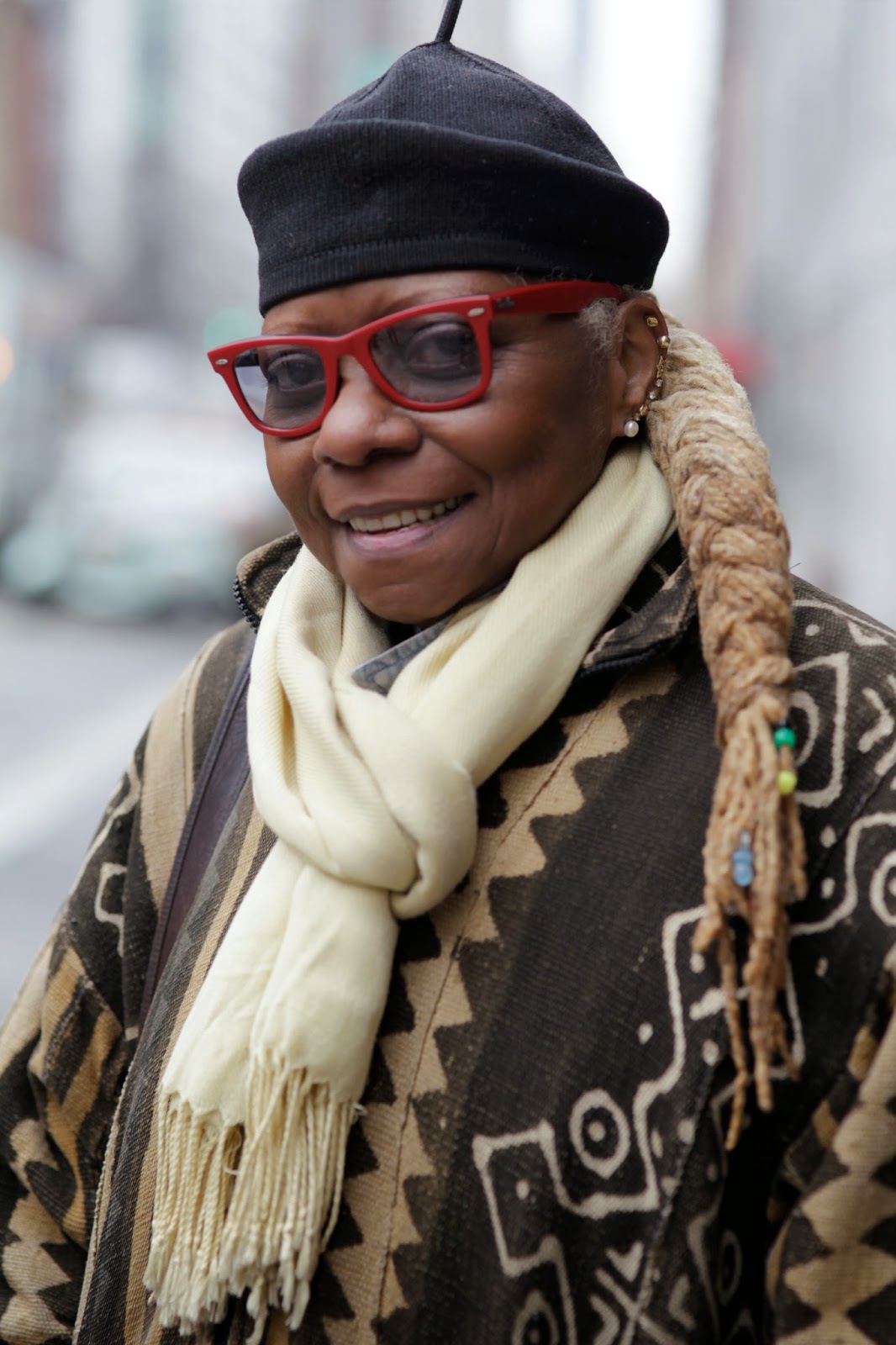
Fab Fashionista
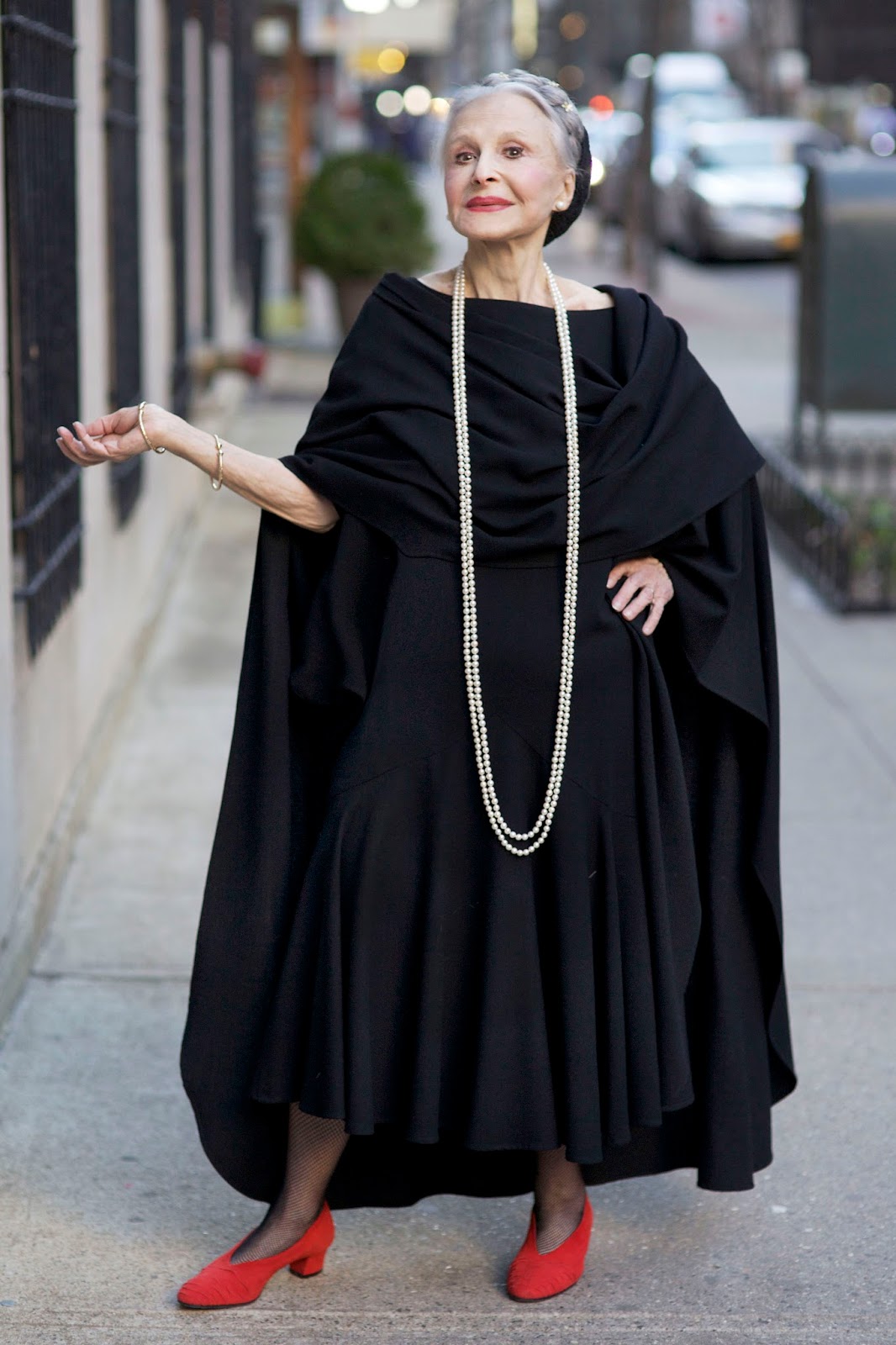
Joyce
…………………………………………………………………………………………………………….
Fashionistas Photos: Red Hat Society Sowystitch and Advanced Style Blog.





 sibylesque