Why We Cannot Imagine Ourselves in Old Age

by Kerry Cue

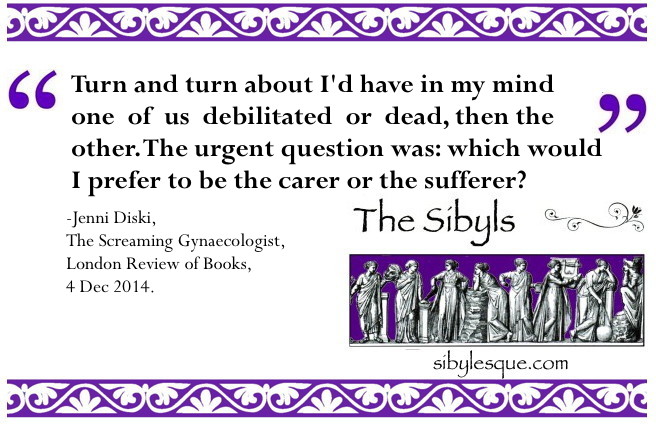
Jenni Diski quote

One thing that Diski (Restricted link: The Screaming Gynaecologist, London Review of Books, 4 Dec 2014) had not anticipated was sudden death. As we age we fear debilitation. We also fear having to – even if willingly – look after a severely debilitated partner. Diski is in her late sixties and has a tumour in her lung. After bouts of chemo the results are uncertain. The tumour was no bigger … nor had it shrunk in size. She had to adjust to living with not only a tumour, but uncertainty. Death hovered a little over 12 months away. Maybe extra time was bought with chemo.

Nothing is written in stone sibylesque

Suddenly, she was confronted with juggling fact and speculation, certainty and uncertainty. How does anyone do this? Diski offers no solution. But her situation is extreme. Her certainty is clear. She has a terminal cancer. Her uncertainty is extreme for she found herself tumbling back to the lacerating uncertainties of her youth. At 12 she’d been placed in one foster home after another following her mother’s catatonic breakdown. She never knew the rules of each new household. Is it OK, for instance, to go to the toilet during the night? She learned to make herself ‘invisible and inaudible’. When Diski was 15 years of age author Doris Lessing became her guardian. This brought it’s own complications.

We can all learn from Diski’s thoughtful piece. We cannot anticipate the troubles of old age. In Diski’s own words:

‘I will continue to live with uncertainty and my inability to do anything about it, the condition I’ve been trying to wriggle away from all my life.’

And so say all of us.

Photo: unsourced
HOME

Train your brain to ease PAIN

by Kerry Cue

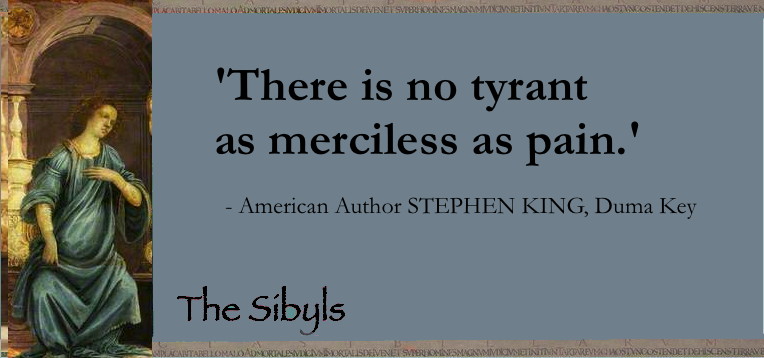
Sibylesque  Pain Quote

The Brain's Way of HealingNorman Doidge, the author of The Brain that Changes Itself has a new book The Brain’s Way of Healing out this week (Scribe). An extract titled Brain Heal My Pain was published in The Australian, 31 Jan 2015, (paywall link) here.

You can find another extract at The Daily Mail (UK)

The extract tells the story of Michael Moskowitz, a psychiatrist turned pain specialist, who suffered from chronic pain for 13 years following a serious accident when he fell off a blow-up ring being towed by a speedboat. His pain was 8 out of 10 on the pain scale (10 is being dropped into boiling oil).

Sibylesque Guernica 3

Moskowowitz began to realise that the areas that process memories, thoughts, movements, emotions and images had been pirated to process pain. He drew 2 maps of the brain one for chronic pain and one with no pain and he visualised the area dedicated to pain in the brain shrinking. He believed that he could reclaim the ‘visual areas’ of the brain where images are processed by forcing it to visualise images of the brain.

Sibylesque Guernica, 2

He was applying the theory of brain plasticity first brought to public attention by Norma Doidge. After one year of persistent visualisation, he was pain free.

There, at the bottom of Pandora’s Box is one word. HOPE. Something we should all visualise, perhaps.

Sibylesque Guernica 1

Photo Source: From Geurnica by Picasso  representing the pain caused by the bombing of Geurnica by the Germans in 1937.

HOME

How to avoid despair in a negative world

By Kerry Cue 

Sibylesque quote F. Scott Fitzgerald

The author of the quote above remains unnamed to give you a moment to reflect on the significance of these words. It strikes me that too many people I know – so it could be my choice of friends – have become cynical and negative as they have aged. Aging is a war where new battles are fought and won daily or, hopefully, where graceful surrender is negotiated. A bitter and twisted demeanor, no matter how tempting, is a debilitating mindset.

So how do we remain positive, not only in a negative world, but at an age when struggle is the only option? Perhaps, the author of the quote is setting down an alternative view, one that also embraces wisdom. Life, after all, dumps on each of us a bucket full of slippery and barbed contradictions: joy and sorrow, blessings and tragedies, pain and relief, certainty and confusion.

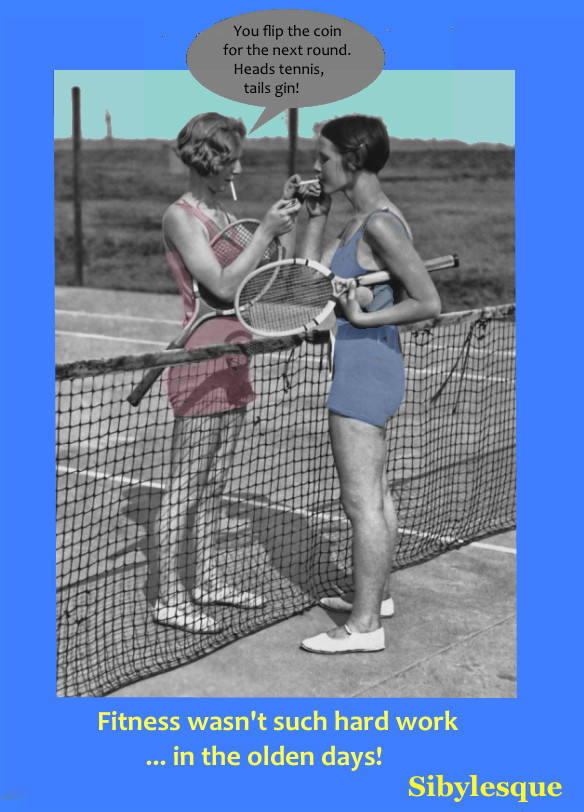
Sibylesque Anyone for tennis

So this is how we counter despair. We juggle it with the possibility of doing good, of making some small contribution.

Who wrote the above quote? F. Scott Fitzgerald. The quote comes from an article titled The Crack-Up published in April, 1936, in which he is brutally honest about his breakdown. He was tired of life. Any reader today would realise he was suffering from depression. He was 39 years old at the time of publication. Fitzgerald died in December 1940 from a heart attack when he was 44.

Other posts on this issue of aging with a postive mindset include At My Age, Doctor, John Glen was an Astronaut and Why you should avoid geriatric talk.

 Photo Source: 1930s tennis women tumblr

 HOME

Understanding the Generations: Dream a little dream with me!

By Kerry Cue

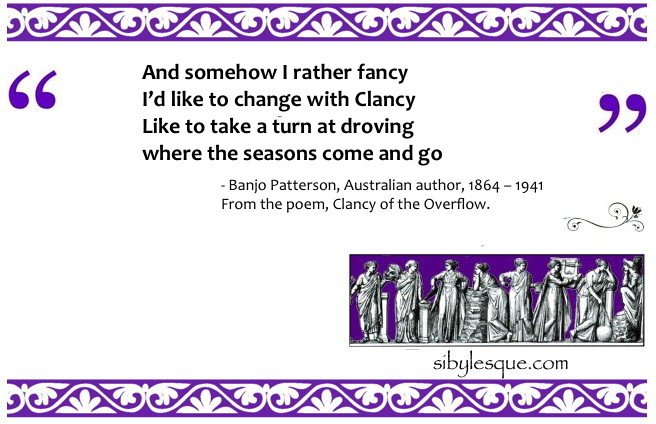
Sibylesque Banjo Paterson Quote  1

In his article, The dream is still a dream in The Australian (A Plus, 6 Dec 2014) on the weekend demographer Bernard Salt wrote a brief but brilliant summary of the different attitudes across the generations. Paywall link.

I would argue that a generation cannot be summarised in a book, let alone in a few words. But Salt is talking about the influences of an era determining a generation’s attitudes. The era you experience as a child, a teen or an adult has a great impact on your outlook on life. Here is Salt’s summary:

The Frugal Generation : Having experienced the Depression and WWII they dreamed of a steady job and a modest home in the ‘burbs. This was security for them.

The Baby Boomers: Born post-WWII the Boomers still dreamed of home ownership. They tied themselves to mortgages (even if, I might add, they dreamed of liberating themselves in other ways)

Sibylesque  4 generations

…………………………

Gen X: Born between 1966 and 1976, Generation X postponed having families for education and to travel. Their dream put “ ‘experiences’ ahead of home ownership”.

Gen Y: Born between 1977 and 1994, the big dream for this generation is ‘self-determination’. You cannot be in control of your life with a mortgage and kids and/or an office job and a boss. Their dream might involve an online start-up (or working in an orphanage in Cambodia). Whatever the case, they don’t just dream about taking ‘a turn at droving’; they pack their bags and go.

More Decent Obsessions


Bernard Salt’s latest book is More Decent Obsessions, MUP.

Photo Source: Genealogy Archives

HOME

I love my mother but I don’t want to have children!

by Kerry Cue

Sibylesque parent worry quoteWhy would a  daughter who loves her mother not want to have children? Be careful what you wish. We feminist mothers wished that our daughters would be free to make their own decisions in life. Nevertheless, we are the first generation of mothers, who cannot assume that grandchildren will appear. I understand why young women, who had difficult mothers may not want children. But young vibrant women who love their mothers … that is a different group. Why wouldn’t they want children?

I had the opportunity to ask a young successful professional woman, this question. She adored, and was also grieving for, her mother who had recently died at the age of 71. The young woman had postponed child bearing until her forties when, fortunately, she gave birth two much loved children when she was 42 and then 45 years of age.

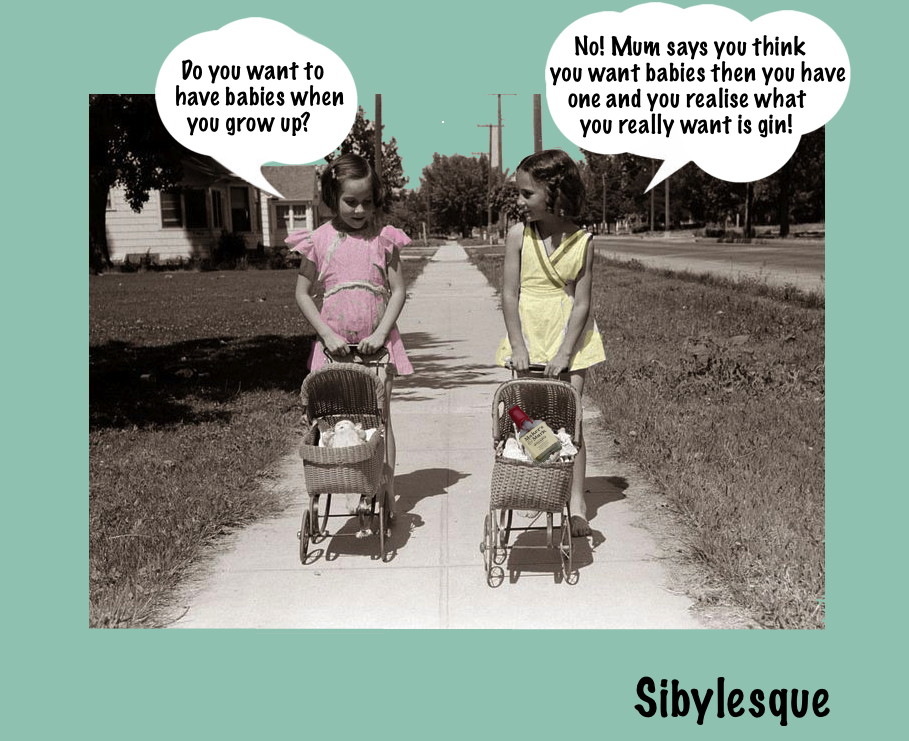
Sibylesque girls with pram 2 vintag.es

So why don’t feminist daughters of feminist mothers want children? Or, some of them, at least. The young woman first cited failed relationships. Some young women stumble through their twenties and then their thirties from one failed relationship to another. I would add job security as another factor. Some young women worry that they cannot afford children.

Nevertheless, this young feminist felt that feminist mothers are so adamant that their daughters establish independent careers, any talk of motherhood gets lost in the conversation.

So you’ve been warned. Maybe all feminist mothers should talk up motherhood a little more. Afterall, when we mothers get together at any age, guess who we talk about?

Photo source: vintag.es

HOME

OMG! It’s Official. I’m a Card Carrying Senior

By Kerry Cue

Sibylesque Kerry Cue Quote 4

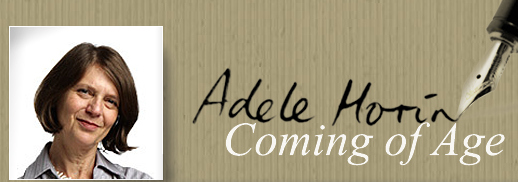
Adele HorinAdele Horin runs the fabulous and informative Coming of Age Blog. In her article, I hate my Senior’s Card, Adele captures the emotions many of us feel from ambivalence to downright hostility when we are first declared a certified senior.

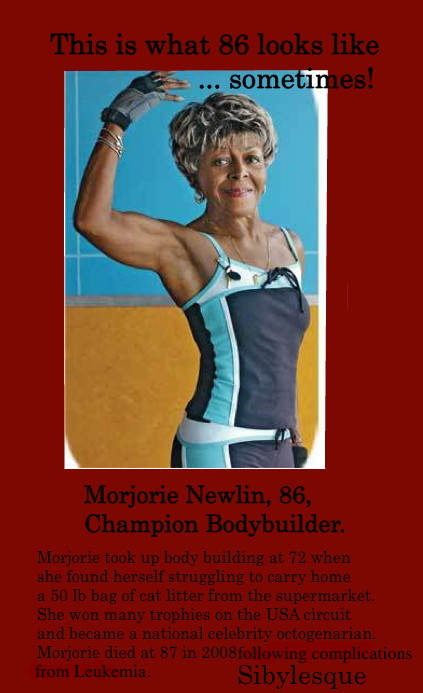
 ‘What boomer can relate to being a “senior”?‘ Adele asks, adding, ‘It reminds me of senior centres where very old people play bingo. I recently cycled 280 km beside the Danube River. I lift weights in the gym. Just a few months ago I was called a worker.’

Adele’s husband suggests she is ‘in denial’, but she protests that now she is lumped in the same age category as her 84-year-old mother. Is this fair? Is it accurate? Could some other word be used to describe ‘younger’ seniors?

Sibylesque Body Builder 86

Adele hates all the baggage the comes with her seniors card, but will she leave it at home. No. She loves the discounts.

 We, THE SIBYLS, declare Adele Horin an Honorary Sibyl for her brutal honesty, sharp observations and her meticulous and thoughtful reporting on age-related topics.


Adele HorinAdele Horin has worked as a journalist in Washington, New York and London covering politics, society and economics. She wrote about social issues for The Sydney Morning Herald for 18 years. Then in 2012, at 62 years of age, she retired from the SMH “not to spend the day in a dressing gown but to think, write, participate, and to engage with my generation in a different way” And her blog, Coming of Age,certainly does engage with her generation on multiple levels.

Photo Source: Coming of Age Blog, pinterest.

HOME

Being Wise about Being Old

By Kerry Cue

Sibylesque tim Wilson Quote

Sibylesque is dedicated to challenging the ‘little old lady’ stereotype and developing a realistic, yet positive outlook on aging. We have already noted that a positive attitude to aging can increase your quality of life, improve your general health and even increase your life expectancy.

Sibylesque Grandmas Rock

Yet wisdom lies in not only tackling life full on, but also knowing when to bow out gracefully. I know a number of males, who have waited until retirement to go wild. Several bought motorbikes for the first time in their sixties. One bought a 1000cc Suzuki. But he was so worried about sitting in the middle of the road on his big bike, he’d only make left hand turns. He’d take ages to ride anywhere because he had to sort of spiral into his destination.

Another 60+ retiree bought a Harley. He won’t ride it in the rain. I picture him riding his Harley holding up an umbrella. His wife/biker’s-moll said he went out riding one day and came back. He forgot his glasses. He went out and came back again. He forgot his boots. Then he forgot his wallet. ‘Do you know what this means?’ she asked me. ‘We’re talking Alzheimer’s on a Harley’. Is he a danger on the road? Should he hand in his helmet? And who decides?

You are the one who must decide in life when it is time, in one situation or another, to take a backseat. The decisions may be BIG. Should I retire? Should I downsize? Should I sell the motorbike? Or, SMALL! Should I get others to climb the ladder? Should I stop wearing those floppy, loose-fitting, and potentially dangerous, shoes?

Life is, and has always been, a gamble. Just like the lyrics of the Kenny Rogers song to be wise about old age ‘You’ve got to know when to hold ’em/ Know when to fold ’em/ Know when to walk away/ And know when to run.’

Until then, Go Grandma, Go!!!!!

Photo Source:  Corbis Images

HOME

If you think you are old, guess what? You ARE aging fast.

by Kerry Cue

Sibylesque Gloria Steinem quote

We, The Sibyls, do not deny age its journey. Nevertheless, many studies have shown that the toxic stereotype of the stooped ‘little old lady’ not only limits your outlook on aging, it can actually reduce your life span. We have noted before that this stereotype is reinforced by Geriatric Self-Talk and assumptions of the medical profession. Now two recent publications support this view.

What if age is nothing but a mind set? by Bruce Greirson (New York Times, 22 OCT 2014) reports on a study conducted by Ellen Langer, Professor of Psychology at Harvard, conducted in 1981. Eight men in their 70s stepped into a monastery retro-fitted for 1959. Perry Como crooned on a vintage radio. Ed Sullivan appeared on a black-and-white TV. After 5 days, the men significantly improved on many ‘age related’ tests.

Sibylesque Go Wild

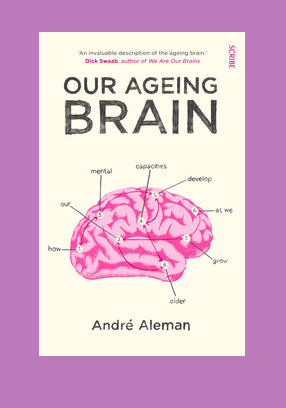
Our aging brain pinkMeanwhile, in his book, Our Ageing Brain: How our mental capacities develop as we grow older (SCRIBE, 2014) André Aleman cites similar studies including the study that showed:

*those with a more positive view of aging lived 7.5 years longer.

*when older people are asked to read a list of negative words associated with aging (eg. Senile) their performance in memory tests reduces.

*men who become prematurely bald present with earlier onset of age related deceases.

*older people in rural China suffer less from memory problems that we do. Professor Langer, who also conducted this study, put this down to their lack of exposure to the negative stereotyping of age we experience in the West.

According to Aleman:

A positive attitude – often perfectly justified, since many older people are in good health – keeps you young.

Photo Source: NYC, 1966, Airbus, Medialapie09 Blog

HOME

I am old … hear me roar in numbers too big to ignore!

by Kerry Cue

Sibylesque Mary Beard Quote 2

Mary Beard, The Spectator

Mary Beard, The Spectator

In the Telegraph, UK, today Prof Mary Beard explains in an article by Hannah Furness (05 Oct 2014), that she aims to reclaim the word ‘old’. Baird, who is recognised by The Sibyls, for her feisty contribution to the feminist debate, has called for a revolution to break down the stereotypes of ‘hunched old lady’ and ‘Darby and Joan’ and claims that “old” should now become something that “fills people with pride”.

Beard was attacked by TV Critic AA Gill in the Sunday Times in his review of her history documentary Meet the Romans for being ‘too ugly’ to be on camera. He also implied that she should appear on ‘The Undateables’, a BBC reality TV show involving mentally disabled and facially disfigured participants.

Has anyone attacked the BBC’s David Attenborough for being ‘too old’, ‘too ugly’ or ‘too mentally disabled’ to appear on TV?

Sibylesque Agatha Christie

This is not just about being old. It is, explains Beard, about being old and female.

Bring on the revolution.

Go get ‘em, Mary!!!

Photo source: The Spectator, unsourced.

HOME

Can you die from a broken heart? Yes! It could happen to you.

by Kerry Cue

Sibylesque Heart Foundation Quote

More women in Australia die from Heart Disease than cancer. This is also true in the UK and the US. This fact often surprises women. We are so attuned to raising money for breast cancer research, we assume it is the number one killer. This misperception makes a heart attack for us dangerous. We don’t recognise the symptoms. We put symptoms like nausea and chest pain down to something we ate or anxiety.

A recent article by Martha Weinman Lear in The New York Times (The woman’s Heart Attack, 26 Sept 2014) highlighted the difference between male and female heart attacks. Martha, who had a heart attack herself, explains that more men have the classic dramatic chest-clutching ‘Hollywood’ heart attack.

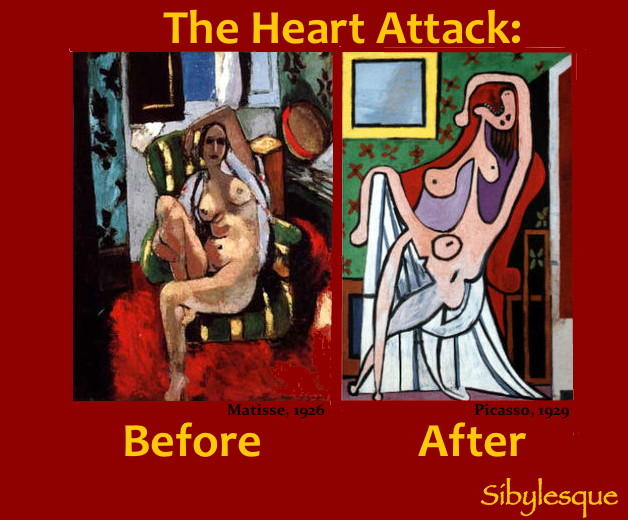
Sibylesque Heart Attack

Most women do not have drama on their side prompting those around them to call an ambulance. The symptoms of a heart disease could simply be fatigue and insomnia. Something that we often assume is NORMAL.

It’s back to the same old message for women’s health. Keep in tune with your own body. Take action when things don’t feel quite right. The life you save may be your own.

HOME