Train your brain to ease PAIN

by Kerry Cue

Sibylesque  Pain Quote

The Brain's Way of HealingNorman Doidge, the author of The Brain that Changes Itself has a new book The Brain’s Way of Healing out this week (Scribe). An extract titled Brain Heal My Pain was published in The Australian, 31 Jan 2015, (paywall link) here.

You can find another extract at The Daily Mail (UK)

The extract tells the story of Michael Moskowitz, a psychiatrist turned pain specialist, who suffered from chronic pain for 13 years following a serious accident when he fell off a blow-up ring being towed by a speedboat. His pain was 8 out of 10 on the pain scale (10 is being dropped into boiling oil).

Sibylesque Guernica 3

Moskowowitz began to realise that the areas that process memories, thoughts, movements, emotions and images had been pirated to process pain. He drew 2 maps of the brain one for chronic pain and one with no pain and he visualised the area dedicated to pain in the brain shrinking. He believed that he could reclaim the ‘visual areas’ of the brain where images are processed by forcing it to visualise images of the brain.

Sibylesque Guernica, 2

He was applying the theory of brain plasticity first brought to public attention by Norma Doidge. After one year of persistent visualisation, he was pain free.

There, at the bottom of Pandora’s Box is one word. HOPE. Something we should all visualise, perhaps.

Sibylesque Guernica 1

Photo Source: From Geurnica by Picasso  representing the pain caused by the bombing of Geurnica by the Germans in 1937.

HOME

Dealing with a Sudden Death in the age of Digital Data

 by Elizabeth Darling

Sibylesque bureaucracy quote

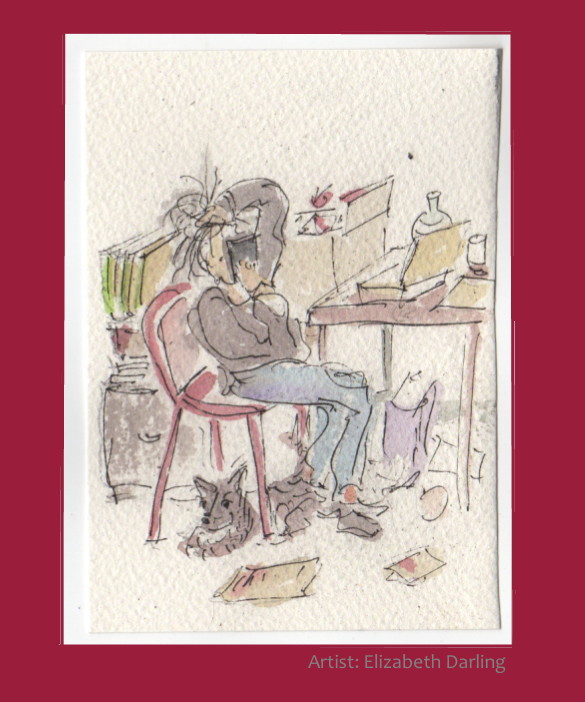
When my partner died unexpectedly my generous local bookseller gave me a book on grief counselling titled “I wasn’t ready to say goodbye”. There are many helpful books on coming to terms with grief and loss. Funeral directors, banks, solicitors; all have handy lists of things to do and organisations to contact. The lists are useful, but if we had prepared ourselves for the possibility of a death and its consequences, I would have had the space and time for grief. I do not write of philosophical or spiritual preparation, I write of ordinary practical arrangements, which need to be made and reviewed during a partnership. I’d like here to share some advice, which will help others find time to grieve, rather than waste emotional effort in railing against petty officialdom.

We had sensibly made wills and written agreements about the form of funeral service and the disposal of ashes. These agreements saw me through the first stages, past the unamused funeral director who could not provide an IKEA style coffin, the disapproving relatives who expected a religious funeral service, and gave me the strength to demand the ashes from the crematorium without purchasing a tasteful urn and plaque for placement in their memorial gardens.

Sibylesque E Darling 4

The next 9 months were filled with time spent, not grieving, but becoming increasingly frustrated and desperate, on the end of a phone, listening to strangers in call centres who were “so sorry for my loss” but who were unable to help me because I didn’t have the required papers, code words or numbers, and who frequently demanded to speak to the person whom I had told them was dead. Although they never used that word, it was always ‘Deceased’. Filling in forms occupied a great deal of time, many required supplementary documentation. Some forms needed to be submitted a number of times.

Here is a list of actions which you should take while your partnership is active to avoid this mind numbing experience:

Store in one place relevant documents and update regularly. There are a number of essential documents; passports, birth, marriage and divorce and death certificates, investment and superannuation papers, tax returns, and whatever will be needed for next year’s tax returns, mortgage and insurance papers, property titles, car registrations, bank records, the Christmas card list; those papers you would save if a bushfire was threatening.

Make sure that there is a secure, accessible, accurate list of all codes for any transactions on the internet, or records kept on the computer system. This must be on paper, not hidden in the thickets of computer files.

Internet banking and direct debit arrangements to pay regular bills for utilities or other service providers create real difficulties. It is a mistake to drift into the habit of allowing one member of a family to manage the finances, especially when the records are held in computer files. I never learned how to operate the details of the accounts package and slowly the household bills had drifted into his name, and were paid from one of his accounts. This made it difficult to prove that I had any involvement, or rights (more on this under superannuation entitlements).

On the death of an account holder, the banks freeze accounts, and direct debits are then not processed. Our bank could not tell me what direct debits had been regularly paid from my husband’s accounts, and we could not access his files (being clever, he had cryptic clues for his codes kept beside his computer but these were incomprehensible to me). I am now unsure whether it is of benefit to be so reliant on the internet as a vehicle for paying bills, although more and more companies are penalising individuals who want to operate on the paper bill system.

Like most, I have an email address. I use my iPad and my iPhone for communication. I can search for information and use the word processor, but like many of my generation I am unable to operate complex computer systems, having left him to write his own research papers and to edit, spellcheck, rationalise, record, and print out mine. If I’d been asked to explain, I’d have said that he couldn’t paint and I can, we didn’t need to double up on skills. Only he knew how to copy, download, make complex documents, take photographs, and add my illustrations to the text; why should I bother to learn all that when he could do it so easily? I had not considered how I would manage on my own. I certainly did not know how to do an etax form!

Sibylesque E Darling 2

Although we were able to access his emails, we had no way of cancelling or changing any of the arrangements he had made. Pushing the unsubscribe button without the specific identity code is useless. Where a transaction is electronic it is not easy to validate if there is a computer failure. Paper bills addressed to the house (which once could be paid by anyone with a cheque book regardless of the name on the account) are no longer posted. Telephone conversations are of little use, Call Centres rely on callers being computer literate and are unable to help if you cannot download forms or fill in forms on the internet or send a fax or pay electronically. Of course we had bought services and items on the internet, but my role had been to decide what: I did not know how. Being required to take a photograph with your iPhone of the screen of your computer, which showed that you have paid the rates and then to take the phone into the rates office to prove that you have paid the rates because their computer does not, seems too ludicrous to be credible. At least chequebook butts and paper receipts are still seen as legal proof.

Keeping records such as tax returns or medical records in the computer, either on the hard drive or on discs in files or in separate memory sticks presents the same problem, if the information cannot be retrieved. Records on parchment in Mediaeval Latin can with diligence and effort be translated – his files defied accomplished hackers.

We should have asked whether it was better to have services or items in both names or one. I had to pay to have my car’s registration and insurance changed into my name, because although I had bought it, it was registered in his name.

Ask your bank what their policy is on joint accounts. Do they freeze the account if one of the partnership dies? Have you arranged your income so either one could remain solvent until probate has been declared? In some cases this can take a long time. The solicitor was prepared to lend me money in the expectation that probate would ultimately be declared, but no one likes to be a supplicant.

Sibylesque E Darling 1Are all the service manuals for appliances kept in one place? They will be necessary if, as in many households, one person only has worked the appliance. I had not learned how to operate the central heating, the 5 remotes for the T.V. and sound systems, the clothes washing machine. He had always stacked the dishwasher. (Well, he never cooked.) I did not know how to start his car or drive the lawn mower. I could not reach the switch for the hot water system. I might never want to mow the lawn, but I should have learned how to change channels on the T.V. and a number of other routine domestic tasks, which had become his province alone.

Is there a list of the tradesmen usually asked to attend to the blown light bulbs, the blocked drains and other routine maintenance? It’s no use knowing vaguely that when the cistern fails it can be fixed by a neat tap with a hammer, somewhere. What you need to know is how all the idiosyncrasies of the house are controlled. Which brick is placed where to hold open the garage door? How is the heating system turned on and off? If the house alarm goes off unexpectedly how is it cancelled?

Whenever you hire a rental property for a self-catering holiday there is a folder of instructions for all appliances, and peculiarities of the house (do not turn on both the heater and the kettle at one time, the fuses blow!). Every household should have one, a current one. Instructions for a beta dvd recorder are of little practical use, but notes on how to play back or change messages on the telephone are essential. A number of callers were so distressed to hear his voice still on the answering machine that they hung up without leaving a message. Some were angry with me. I should have known that they would find it distressing.

Make a priority list: some things can wait, some can’t. The funeral director, your solicitor, or the bank will give you a list of organisations, which need to be informed. It is not their role to tell you how long each task will take, or how difficult dealing with each organisation will be. Grief and shock would seem to affect the memory and organisational ability. In a bound book, (scraps of paper lose themselves), make notes of the questions you need answering. Record all conversations. Cross off what has been achieved, on despairing days it is sustaining to see that you have made some progress.

Sibylesque E Darling 3

Decide who can be reliably asked to help and prepare to be vague with others – not everyone who offers to help, can, and you need a bland response, which will acknowledge their offer but not commit you. You have to protect yourself!

Before you make a phone call to an institution (Origin Energy perhaps) or visit one (Vic Roads, for example) check that you have all the documents you will need, and time.

When ringing Call Centres have a novel at hand: I read 2 chapters while on hold to a line to a call centre in W.A. trying to change the name on an account.

Listen carefully to the instructions as to which button to press. I have spent an hour in a queue only to find I was talking to the wrong department.

Remember the individual on shift on the line’s end or at the counter in an institution may know that it is necessary to offer condolences (the manual tells them so) but it is not necessary to deviate one bit from the job description. Be prepared to demand to speak to the supervisor.

It is better to hang up or walk away than to lose your temper or self-control – the only person who suffers is you! As soon as the shift is finished, the operator is done with your problem. You still have to resolve it. (I lost my temper in the Roads Board Offices, with a subsequent migraine headache although I was right, and she was wrong, I had to go back the next day and start again, she simply moved onto another customer)

A Certified copy of Death Certificate is necessary, and of the Will, before any organisation will change anything. Find an amenable JP and get him to certify at least twenty copies.

In general, do not assume that any organisation will be swift to respond. Ask how long it might be before a reply can be anticipated, and follow up if the reply is not timely. It was 10 weeks before we received a death certificate and then only because we persisted. The clerk had been unable to read the doctor’s handwriting so had done nothing to process the form. This is a useful reminder to ensure legibility…

If Superannuation and insurance policies were set up by a partnership with the expectation of supporting the survivor, it is important to know beforehand what the support will be and how it can be accessed. The old Commonwealth Superfund, for example, not only requires a copy of Death Certificate and Will, but also of joint household bills, and other proofs of identity and cohabitation This, they cheerily informed me, was to prevent identity fraud, Who would want to be.

Erithrean Sibyl crop .

Elizabeth Darling is a dynamic thinker, meticulous writer and recent widow, who lives in rural Victoria.

HOME

Views of Depression: Inside and Outside

by Kerry Cue

Sibylesque  Joseph Campbell

Anyone over 60 or, more likely, 50 knows loss and grief that can also slump into depression. We cannot duck the ‘slings and arrows of outrageous fortune.’ But for some, the shadows of depression appear to fall over them at birth.

I ran into a friend yesterday outside the supermarket. In his late sixties, he has suffered depression on and off from childhood. Meanwhile, Robin William’s tragic suicide was dominating all news bulletins. My friend recalled when, walking past the CBS studios in New York last year, he and his wife put their names into the lottery to be in the Late Night with David Letterman audience. They won seats. And who was on the show? Robin Williams. We shook our heads dumbfounded, yet again, by the inexplicable tragedy of life.

There is an inside and an outside view of depression.

Sibylesque sadThe outside view witnessed by a friend or family member, perhaps, can be quite cynical. The depressed person, bereft of all vitality, appears monotone, unresponsive and self-obsessed. Yet this is depression’s – sometimes unyielding – punishment. It winds the walls in on the depressed person until there is no way to connect to the outside world. Yet the pain persists.

In 1998 David Foster Wallace published a Harper’s Bizarre piece called, simply, ‘The Depressed Person’. It follows a depressed woman’s growing self-absorption. Such a bitter outside portrayal of obsessive melancholia seems all the more tragic as Wallace, a highly celebrated author, committed suicide from depression in 2008 at the age of 46.

The inside view of depression is chilling. ‘The opposite of depression is not happiness, but vitality’. So began the TED talk Depression, the secret we share by long-time depression sufferer and author Andrew Solomon. Meanwhile, the New York Times recently published one of the most brutal, raw and painfully honest portrayals of depression I have read. A Journey Through Darkness by Daphne Merkin (New York Times, 6 MAY 2011)

sadgirl onwoodMerkin, 60, an American literary critic, essayist and novelist, has suffered, sometimes untreatable, depression on and off since her childhood.In some way, the quiet terror of severe depression never entirely passes once you’ve experienced it. It hovers behind the scenes, placated temporarily by medication and renewed energy, waiting to slither back in, unnoticed by others … It tugs at you, keeping you from ever being fully at ease. Worst of all, it honors no season and respects no calendar; it arrives precisely when it feels like it.‘ Both Solomon’s and Merkin’s stories have – if not exactly happy, at least – liveable endings.

Merkin, who had suicidal thoughts and whose long-term Freudian analyst started pushing ECT (Electro Compulsive Therapy) wrote ‘And then, the Sunday afternoon … something shifted ever so slightly in my mind’. And later ‘Everything felt fragile and freshly come upon, but for now, at least, my depression had stepped back, giving me room to move forward’.

Memory is vital to the depressed person’s recovery. If they can recall being happy once, the possibility echoes in the coal-black gloom of their thoughts that one-day they can return to that bright yet unfathomable place. Some depressives  struggle to hold onto even one happy thought as if the lines are down in the power network of the brain. Other depressives believe that because their life has been changed by, say, a divorce, they cannot find their way back to that happy state. These are the machinations of the mind therapists address. Nevertheless, one happy thought remembered can deliver Pandora’s gift. Hope.

Sibylesque Melancholia

Depression Resources:

Beyond Blue Australia: Crisis helpline, facts, forums and resources

Health Talk Online: Experiences of depression and recovery in Australia

Healthtalk online UK: Experiences of depression and recovery UK

Youth Health Talk UK: Young Peoples’ depression and low mood

Healthtalk online UK: Experiences of Antidepressants

MAYO Clinic USA: Depression causes, complications and symptoms

MAYO Clinic: Depression Medication

MAYO Clinic USA: Minimising Sexual Dysfunction Side effects of anti-depressants

Black Dog Institute Australia: Education Resource

HOME


Help! My Bubble Wrap Kid Just turned 40

by Kerry Cue

Roman border  dark red

dark red quote 1

‘My eldest daughter is 32 this year. So this is the one raised in the early 80s when Penelope Leach was the guru. Anyway, excuse me!

Bloody Penelope Leach where you had to be breast-feeding continually and everything was baby centered and child focused and you always had to stimulate the baby and raise their self-esteem.’

dark red quote 2

     ………………………..Virginia, NSW, RN, Life Matters, ABC Talkback,28 MAR 2014

Sibylesque Signature dark redRoman border  dark red


…………………………………………………………………………………………………………………………………………………………

Does Helicopter Parenting Harm Kids?

your-baby-and-child Penelope LeachOnce parents felt their role was to feed and clothe their children, and wash behind their ears (for some reason). In the 1970s, however, a Parenting Revolution emerged. Suddenly, every stage of a child’s development (when they goo, poo, smile, sit etc) demanded parental supervision and emotional support. The new era of Helicopter Parenting had begun. UK psychologist, Penelope Leach, was a flag bearer of this revolution.

Her book, Your Baby and Child: From Birth to Age Five (1977), became the child-rearing bible for many parents, myself included. She provided useful information about snivels and rashes, but constantly boosting a child’s self esteem demands extreme vigilance. Children will fall over. They will come second in a race. They will get B in a test. So a parent had to stay vigilant and always cheer their child’s efforts (even the most lame pasta art effort).

Sibylesque Career Advice

Now it is time to ask: Does Helicopter Parenting Harm Kids? It can. In his book, How Not to Talk to Your Kids (2007), American journalist Po Bronson warned that constantly praising kids means ‘they never learn strategies to deal with failure’. Bubble Warp kids can become ‘risk adverse’ simply because they can’t deal with the emotional impact of failing.

We Sibyls were the first, if fairly moderate, Helicopter Parents. Our children are now adults so we can comment on some of the long-term outcomes as we observe the first ‘Bubble Wrap kids’ as they turn 40.

Bubble Wrap kids never have to share, never have to wait and never hear the word ‘No’. What would that look like when those kids are 40 years old. Ugly! Very ugly. Who would want to live with a Me-centric 40 year old who won’t share, wait, doesn’t take ‘No’ for an answer yet also needs constant emotional support? This isn’t just narcissism, it is needy, clingy narcissism. They will suck the emotional life out of any partner or mother (See Why are Feminist Daughters Angry with their Mothers.)

And one more thing. Will Bubble Wrap kids want to have children of their own? Maybe not. Firstly, children raised Helicopter-style have seen their parents hovering first hand. It looks like hard work.

And, secondly, having children involves risk. For ‘Bubble Wrap Kids’ the idea is terrifying. What if something goes wrong? What if the child is hideous? What if I can’t handle being a parent? Why do it? Having children is way, way too risky!

 …………………………………………………

Photo Source: Klein Letter Archives

HOME


Why are feminist daughters angry with their mothers?

by Kerry Cue

Roman border  dark red

dark red quote 1We’ve given those girls everything.

We’ve raised them to be feminists.

And they turn around and they hate their mothers.
dark red quote 2

     ……………………………………Virginia, NSW, RN, Life Matters, ABC Talkback,28 MAR 2014

Sibylesque Signature dark redRoman border  dark red


…………………………………………………………………………………………………………………………………………………………..

Is this a new syndrome?

When this talkback segment came on the radio I nearly ran the car off the road. This was brutally honest comment, talkback radio at its best. I had to stop the car and listen. Here is Virginia, NSW, again:

‘My daughter is 32 this year …. Anyway, that generation of girls … all highly educated, all got degrees, very career driven young women … but I’ve noticed there is a real syndrome among my friends … I’m now 60 …those girls … are very critical and, I would say in some cases, downright abusive of their mothers. … We talk about it among ourselves and it’s horrible. Virginia, NSW, RN, Life Matters, ABC Talkback,28 MAR 2014

Sibylesque Mummy said 3What’s going on? Surely feminist daughters are independent, self-determining young women, who do not depend on their mothers. Or, could it be that Helicopter Parents – across the parent spectrum from mild hoverer to tyrannical Tiger Mum – have created needy offspring? Helicopter parenting began in the 1970s when Penelope Leach and other child rearing gurus urged parents to build their children’s self-esteem. Parent’s had to be hyper-vigilant in case their child missed out on an A, or an invitation to a party, or being picked for a sports team to make sure their child’s self-esteem didn’t collapse like a house of cards.

Mea Culpa. Many parents from the 1970s on are guilty to some degree of fretting over their child’s self-esteem. But this brings about another problem: EMOTIONAL DEPENDENCE. In her article, The Ties that Unwind (The Weekend Australian Magazine, 1 Mar 2014),

babies-and-their-mothersKate Legge explored the different expectations children have of parents across the generations. There has been a generational shift. People aged 60+, says Kate, grew up believing that children should be fed, clothed and schooled (and, therefore, loyal to the family.) Whereas younger adults between 30 and 50 want and often demand EMOTIONAL SUPPORT and if the parents are not forthcoming they will go elsewhere – to friends or therapists – to get it.

This is the Catch 22 of modern parenting. Children, obviously, need emotional support. (There. There. Did the big, bad thunder frighten you?) But children also have to mature into independent young adults. (Yeah! Life’s a bitch. Suck it up Princess.) In his article on Slate.com, Teen Spirit: Helicopter parenting has crippled American teenagers: Here’s how to fix it, American psychologist, Dan Griffin, calls this parental role change as moving from the more cheerful, obviously, Cheerleader to tougher Coach. But how do parents get this move right?

Could the angry daughter syndrome be related to the feminist mantra: You can be anything you want to be. You can have it all? Mothers, teachers and career advisers wanted each girl to realise her full potential. This mantra was delivered with enthusiasm and the best intentions in the early days of feminism. (Have a look at Australian Content Magazine For Women Who Want It All)

the-tibertine-sibylThis is fine talk for a cheerleader, but as a tough coach the possibilities are unintentionally overstated. A girl cannot be anything or everything she wants to be. She cannot become an A-grade tennis playing, ballerina, plumber, film-star-lawyer princess-bride, for instance. Maybe, just maybe, these daughters are angry with their mothers because ‘mum’ promised them the world and the world hasn’t delivered. Besides, mum is meant to fix everything, isn’t she? As paediatrician Donald Winnicott wrote in 1953, the Good Enough Mother must fail, eventually, to fulfil her child’s every need. Yep! That sounds about right. Suck it up princess.

Then again, as the first batch of feminist daughters of stay-at-home mothers, we were often outlandishly critical of them too. And so the wheel turns.

Dance photo:Alice Murdoch Adams dance school in Calgary  from the chronicallyvintage blog

…………………………………………………

HOME


Why you should avoid geriatric talk

Roman border  dark red

dark red quote 1


I’m not senile… If I burn the house down it will be on purpose.dark red quote 2

…………………………………..Margaret Attwood, The Blind Assassin

Sibylesque Signature dark redRoman border  dark red …………………………………………………………………………………………………………………………………………………………………

Age makes weary, but words condemn.

senior hippies wrinkleOld age creeps up on us all, but we can stay lively all our lives. Old Age, however, has had a long history of bad press. As a consequence, it is very easy to develop a ‘geriatric’ mindset and start using geriatric language. This is how it works. One day, without realising it, you say ‘I had a fall’ rather than ‘I fell over’, ‘I had a funny turn’ instead of ‘I felt dizzy’ and ‘My mind is going’ or ‘I can’t remember a thing’ in stead of ‘I forgot’.

This is important. Research shows that immersing yourself in ‘debilitating’ language slows you  down. Scientists have actually measured the walking pace of subjects. Young and old. The reverse is also true. Using ‘energetic’ language will speed you up.

What more can I say? Go wild. It’ll do you some good.

Reference: How to Age, Anne Karpf,  The School of Life (2014), p48

HOME