The Sibyls
Photo: Unsourced

Shattering Stereotypes
The Sibyls
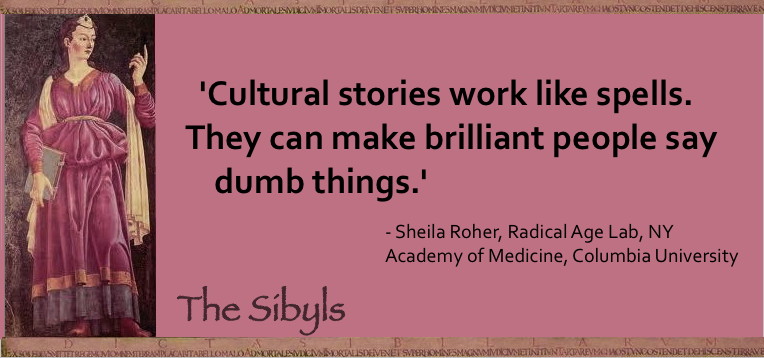
We Sibyls are concerned with the impact negative attitudes to aging have on our health. Toxic stereotypes of ‘the little old lady’ are prevalent in the medical world, At my age doctor John Glen was an astronaut, in the media, If you think you are old guess what? You are aging fast and in our own conversations, Why you should avoid geriatric talk.
Sometimes, however, we don’t realise just how ingrained these attitudes are in the culture. In this fascinating lecture Sheila Roher, founder of Radical Age Lab, University of Columbia, asks the audience ‘how many of you were told when you were a child or a teenager that these are the best years of your life?’. ‘That’s a terrifiying statement!’ exclaims Roher. ‘Like I peaked at nine … middle school is it?’
Watch the video for some profound philosophical thinking on aging.
You will find more discussion on this topic at Radical Age Movement Blog.
by Kerry Cue
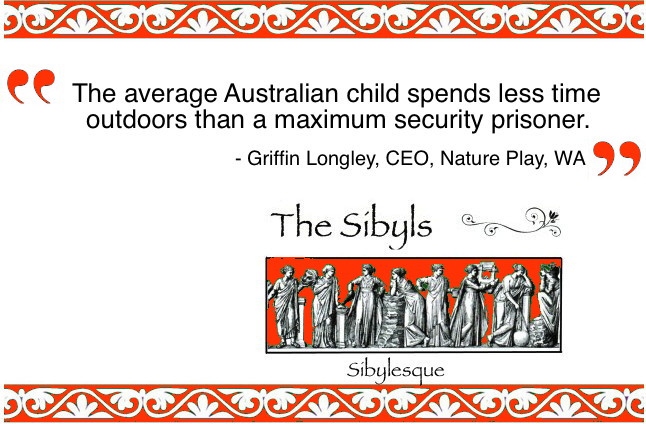
We are the generations, who roamed free. We rode our bikes unsupervised. Explored the neighbourhood. Played in the street. Our grandchildren live indoors. (See The Last Child in the Woods book review) This is cause for great concern. Sibyl Helen Elliott writes about the joys of taking grandchildren into nature. There is another side to this story. Childhood is diminished if children do not experience nature. Now the research confirms our fears.
Results from the Australian State of Play Report, 2012, comprising 8 – 12 year old children, their parents and grandparents published in Primary Focus, the SAPPA (South Australia Primary Principals) Magazine include:
*Indoors: 9 out of 10 kids spend more time playing inside than out.
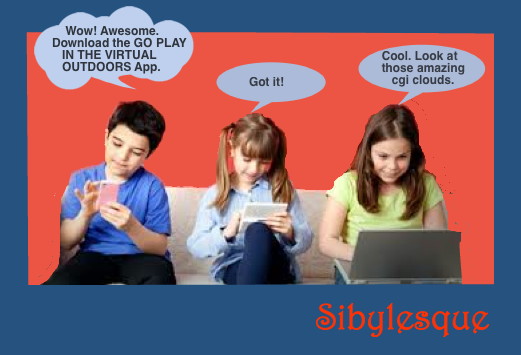
*A lack of inspiration: 37% of kids run out of ideas for play.
*A lack of time: Afterschool activities limit the time children have to play outdoors.
*A lack of opportunity: 37% of kids report they don’t have anyone to play with outside as almost half the kids they might play with are indoors plugged into technology.
“A growing body of research shows us that outdoor play leads to better physical and mental health, has positive effects on cognitive function and learning, and reduces the incidence of behavioural problems.” Maria Zotti, Nature Play, SA.
Peter Dunstan, Principal Kilkenny PS, SA, writes in Primary Focus that outdoor play fosters “wonderment, independence and freedom” as well as “social skills, imagination, creativity and problem solving”.
So concerned are the South Australian Primary School Principals they have combined with Nature Play, SA (A NFP organisation) to promote outdoor play. Nature Play, SA has produced this poster: 51 Things to Do before you’re 12. Pass it on!!!!!!!
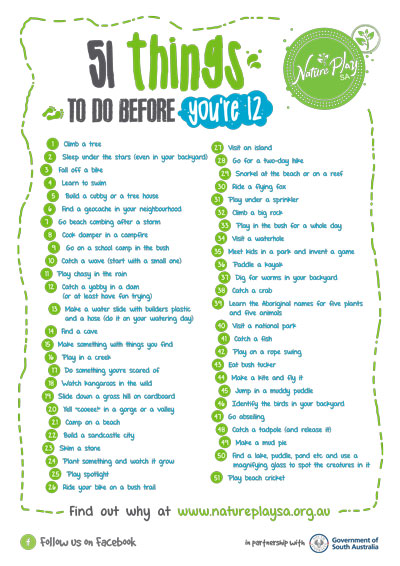
Photo: Unsourced
By Helen Elliott
Easter was sublime here in the country. It was cold at night and the days remained crisp. The family were staying for a few days and because there were babies and toddlers the house needed to be kept warm, mostly by the open fire that astonished the children. They all live in centrally heated houses.
Outside the garden was modestly, quietly preparing itself for winter. The golden ash no longer dazzled along the drive but it’s leaves made a russet eiderdown for the bright shoots of bulbs beneath. The huge maple by the creek still flies banners of crimson and orange and the children gasp at the size of the leaves. And the shapes. They hold them out against the palms of their hands and make us look. They have seen leaves in books but not like this, scattered across the grass, tumbling in the water.
Two of the children are old enough for an Easter egg hunt, and on Easter Sunday with the mist still blooming above the tallest gums, bundled into their coats, their crazy pink gumboots and cherry- red hats they waited by the kitchen door holding their new buckets. Their parents each hold a swaddled, rosy-checked baby and everyone is wondering where a rabbit might leave eggs. Had I glimpsed him that very morning? Fat? Silver fur? Tall brown ears and a great puff of a tail? I had a few suggestions about where he might have been.
 I was right. Over by the fence where the climbing rose is finishing the season with a few tawny buds amongst the crowd of rosehips two perfect golden eggs are lying. The little girl’s joyful screams pierce the morning air startling two birds out of hedge. They flap vertically into the sky. Where else would that rabbit go, the children wonder? Under the Irish strawberry? Or maybe if they bent down and lifted the tips of the branches of the Chinese elm where it sweeps the earth and crept into that glade they’d find something? Again their screams of delight, again their sparkling faces.
Olivia rushed to the first of the jelly bushes, certain that the rabbit would have been there. She was enraptured by the jelly bushes because when you shook them, or polished them they wobbled like jelly! To us they are common English box bushes but they’re shaped like small urns and are just the right height for a three year old to shake. Alas, not one golden egg wobbled from the deep green urns.
And nothing was found in the old fountain except an upturned pot. Nothing? Well, there was a tiny striped frog. Half lime and half olive. The girls wondered if he had a name. And shouldn’t he live in the pond? Continue reading article here: Frogs, Thornbills, Crimson Leaves and Cycla-Men- The Many Enchantments of the Natural World
…………………………………………………………….
 Helen Elliott is a thoughtful and analytical reader, informed and soulful writer and unyielding literary critic for many Australian newspapers. She is also a dedicated gardener. After down downsizing the family home and moving into an apartment Helen longed for her garden. You will find her insightful thoughts on this experience here.
Photo Source: Stairs marksinthemargin blog.
by Ruth McIntosh
I have just spent two hours staring at an eye I’m painting. What happened? Where did the time go?…and I still haven’t done the other one!
Being an artist is a lonely business but wonderfully transporting at the same time. Transporting where though? Well, transporting away from everything except those colours and that purpose in front of me to achieve Charlottes’ eye and all that it conveys.
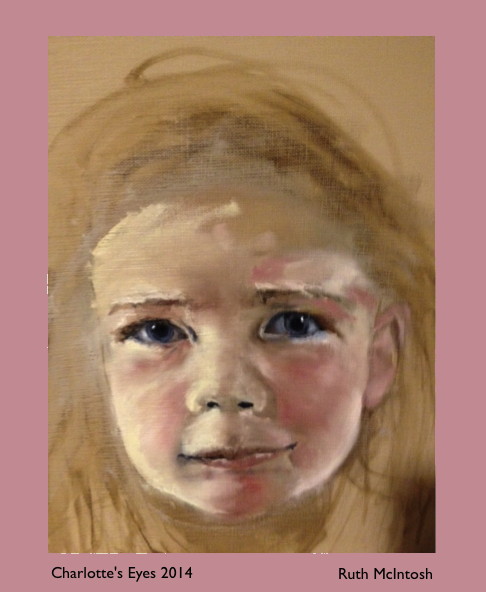
One of the most important and difficult things I have come to terms with in painting is that most of the art I produce is simply practice and therapy, not some end product. The image is usually being wiped off, or painted over.
However the therapy is blissful. Putting on the music, singing at the top of my voice intermittently after making some strokes, having moments of immense energy accompanied by beautiful quiet interludes. Not thinking about dinner, children or any domesticities. Ahhh, bliss!
My studio is full of visual evidence of my whimsical thoughts. Sometimes it’s a bit depressing and sometimes it’s very comforting. My visual diaries document my life with amazing accuracy even without words.
Well, that’s enough of this little interlude and its back to Charlotte and the other eye and the smell of paint, turps and the heavy decision of which music to play. I’ll see the world in another two hours!
………………………………………………………………………………………………………..

Ruth McIntosh
Ruth McIntosh is an extraordinary and passionate artist, who has been involved in art and art education for many years. She has held various solo exhibitions and has been involved in group shows. Ruth specializes in portraiture using both traditional methods of oil on canvas/linen and incorporating experimental use of media. Ruth is committed to extending her art to enjoy the riches of traditional workmanship alongside the excitement of contemporary application.
Her website is: Ruth McIntosh
 sibylesque